Senate Finance Committee Chairman Wyden has officially begun again taking into account the legislation, a suite of tax credits, to the big polluters and their allies managed to run from Congress, including important, sensible policies that promote clean energy.
Franz A. Matzner is Associate Director of Government Affairs for the natural resources Defense Council. His political background includes forestry, energy and climate change. He had the position of senior policy analyst for the agricultural...
Here, create your free account to sign up for our free e-newsletter:
View the original article here
Showing posts with label future. Show all posts
Showing posts with label future. Show all posts
Sunday, April 13, 2014
Fiscal code of Honor: Congress must choose a clean energy future
Sunday, April 13, 2014Ярлыки: choose, Clean, Congress, Energy, fiscal, future, honor 0 коммент.


Monday, December 02, 2013
What the Energy Future Looks Like: West Village, University of California at Davis
Monday, December 02, 2013
In the global competition for appealing clean energy solutions, a leading entry is the new West Village at the University of California at Davis (UC Davis), which today celebrated significant progress toward its goal of becoming the largest planned “zero-net energy” community in the United States.
Seven years ago, I was one of nine jurors who selected the winner in a competition to establish the nation’s first university-based center on energy efficiency (and yes, it’s hard to believe that this didn’t happen until 2006!). UC Davis finished first in a distinguished field, and it has more than justified expectations in the years since.
Among the Energy Efficiency Center’s proudest achievements is the beautifully designed space next to the main campus that bills itself as the nation’s largest planned community to reach “net zero” — annually consuming less electricity than it produces while emitting no carbon pollution.
The “West Village” is proceeding in stages and will ultimately house 3,000 students, along with 500 staff and faculty families and a cluster of retail and commercial buildings. By making those buildings far more energy efficient than even California’s rigorous standards require, the West Village architects were able to balance all their projected electricity needs with onsite solar photovoltaic (PV) power production. The UC Davis Center made a commitment to regular evaluations of the West Village’s performance, too, and the inaugural report was released this week.
The Results
In the first year of substantial occupancy and fully powered PV systems, roughly 1,500 people in more than 500 apartments and a half-dozen mixed-use buildings came hearteningly close to “zero net-energy”: about 87 percent of the way, to be precise. Thanks to local experts from the Davis Energy Group, we know pretty much exactly what caused the gap, and what to do about it.
The solar power systems performed pretty much exactly as advertised, although the evaluators think we can squeeze out a few more megawatt-hours of electricity with occasional cleanings of the solar panels (to remove dust emanating from local agricultural operations). Also operating as predicted were the buildings’ cooling and heating systems, and the one- and two-bedroom apartment units taken as a group. Consumption was higher than expected in two principal categories: three- and four-bedroom units, whose occupants loaded up on plug-in electronics and showed remarkable variation in monthly electricity use; and water heat, where a high-efficiency technology relatively new to U.S. markets (heat pumps) created some siting and operational problems that contributed to higher power use.
Looking Ahead
The West Village managers are confident that they can cover the remaining distance to “zero net energy,” and I agree with them. The water heating glitches are already mostly fixed. For the larger apartments, a host of strategies are being deployed to identify and motivate the largest electricity users to waste less energy, starting with the repeatedly proven social science insight that the best way to change behavior is simply to show people that their neighbors are doing better.
Regular performance reports will help with that message, as well as show the world continuing progress and any remaining barriers to reaching the community’s laudatory goals.
The next West Village performance review is due in early 2015. I look forward to sharing the results, and I’ll close with the quote that I authorized for use in the news release accompanying today’s report:
“The West Village is what a sustainable energy future looks like for California and the rest of the world. Its commitment to comprehensive evaluations like this one is an important part of the good example that the community is setting for all the rest of us.”
This article was originally published on NRDC's Switchboard and was republished with permission.
View the original article here
Seven years ago, I was one of nine jurors who selected the winner in a competition to establish the nation’s first university-based center on energy efficiency (and yes, it’s hard to believe that this didn’t happen until 2006!). UC Davis finished first in a distinguished field, and it has more than justified expectations in the years since.
Among the Energy Efficiency Center’s proudest achievements is the beautifully designed space next to the main campus that bills itself as the nation’s largest planned community to reach “net zero” — annually consuming less electricity than it produces while emitting no carbon pollution.
The “West Village” is proceeding in stages and will ultimately house 3,000 students, along with 500 staff and faculty families and a cluster of retail and commercial buildings. By making those buildings far more energy efficient than even California’s rigorous standards require, the West Village architects were able to balance all their projected electricity needs with onsite solar photovoltaic (PV) power production. The UC Davis Center made a commitment to regular evaluations of the West Village’s performance, too, and the inaugural report was released this week.
The Results
In the first year of substantial occupancy and fully powered PV systems, roughly 1,500 people in more than 500 apartments and a half-dozen mixed-use buildings came hearteningly close to “zero net-energy”: about 87 percent of the way, to be precise. Thanks to local experts from the Davis Energy Group, we know pretty much exactly what caused the gap, and what to do about it.
The solar power systems performed pretty much exactly as advertised, although the evaluators think we can squeeze out a few more megawatt-hours of electricity with occasional cleanings of the solar panels (to remove dust emanating from local agricultural operations). Also operating as predicted were the buildings’ cooling and heating systems, and the one- and two-bedroom apartment units taken as a group. Consumption was higher than expected in two principal categories: three- and four-bedroom units, whose occupants loaded up on plug-in electronics and showed remarkable variation in monthly electricity use; and water heat, where a high-efficiency technology relatively new to U.S. markets (heat pumps) created some siting and operational problems that contributed to higher power use.
Looking Ahead
The West Village managers are confident that they can cover the remaining distance to “zero net energy,” and I agree with them. The water heating glitches are already mostly fixed. For the larger apartments, a host of strategies are being deployed to identify and motivate the largest electricity users to waste less energy, starting with the repeatedly proven social science insight that the best way to change behavior is simply to show people that their neighbors are doing better.
Regular performance reports will help with that message, as well as show the world continuing progress and any remaining barriers to reaching the community’s laudatory goals.
The next West Village performance review is due in early 2015. I look forward to sharing the results, and I’ll close with the quote that I authorized for use in the news release accompanying today’s report:
“The West Village is what a sustainable energy future looks like for California and the rest of the world. Its commitment to comprehensive evaluations like this one is an important part of the good example that the community is setting for all the rest of us.”
This article was originally published on NRDC's Switchboard and was republished with permission.
View the original article here
Ярлыки: California, Davis, Energy, future, Looks, University, Village 0 коммент.
Sunday, October 27, 2013
New Optimism for a Cleantech Future
Sunday, October 27, 2013
If you've not been paying much attention to cleantech in the last little while, it's time to sit up and take notice — because post-Solyndra, cleantech has been quietly gaining momentum.
We had the chance to take a close look at the fundamentals of cleantech over the last two months in co-authoring a new (and free!) 38-page research report in conjunction with Oakland, Calif.-based advocacy group As You Sow and the Responsible Endowments Coalition of Brooklyn, New York.
Titled Cleantech Redefined: Why the next wave of cleantech infrastructure, technology and services will thrive in the twenty first century, the paper analyzes the most recent investment research available across a number of industries and major impact areas. It identifies key drivers and market size projections for various cleantech categories. It looks at examples of products and technologies currently on the market. Finally, it highlights a handful of large, mid and small cap firms and funds as possible points of entry for investors within each industry.
The paper does a good job of introducing cleantech and its significance (e.g. even only being a relatively new investment theme, cleantech is still — even today after a downturn — attracting nearly a quarter of global venture capital available.) It re-emphasizes cleantech's multi-trillion dollar individual addressable markets of power, water, agriculture, transportation and others. And it restates the significance of cleantech's drivers, and that they're not going away any time soon.
But to me, one of the most interesting sections of the report compares the cleantech wave to other technology booms of the last 50 years, like the dot com boom, the networking craze, biotech, the PC and the microprocessor. We found a number of parallels and a number of reasons for optimism when you compare the cycles. After 20 years in technology, personally, the more I looked at the data, the more it felt like I'd seen this movie before.
For instance, the downturn in venture capital: Venture capital often spikes early in emerging categories, later to be replaced with more traditional levels of investment and other sources of capital as industries develop. It happened in the Internet era, and this transition has begun in cleantech as shown below; venture capital is playing less of a leading role in driving cutting edge technology, as it's being being augmented by corporate investors and other sources of funds. More detail in our report.
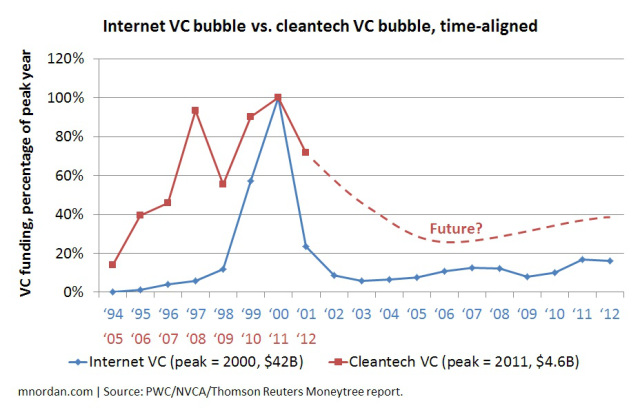
Actual and estimated venture capital spending in Internet and cleantech. Source: Matthew Nordan
There's another relevant curve, below, that looks a lot like the one above. We hypothesized in an analysis this summer that cleantech had bottomed out on the Gartner hype cycle. We make the more detailed case in our report that cleantech, as in every one of the previous waves I just mentioned, had experienced the same initial enthusiasm, the same frothiness, the same "irrational exuberance" as Alan Greenspan put it, that these other technologies did as expectations initially exceeded reality.
As the Gartner model below illustrates, in every one of these previous waves, there was a correction, and a gradual equalization of expectations and execution. Our analysis, detailed in our report, is that cleantech is now starting to climb out of what Gartner calls the "trough of disillusionment" and up the "slope of enlightenment" (how very Zen).

Hype cycle of expectations over time related to cleantech. Source: Gartner
And cleantech IS climbing out. If you look at broad-based cleantech funds as a proxy for the cleantech theme, there's been solid growth the last few months. Yes, cleantech returns have been generally poor for investors the last few years. But there have been bright spots in certain sub-sectors such as clean energy generation, solar services and transportation. The lift from high cleantech fliers like SolarCity (NASDAQ: SCTY) and Tesla Motors (NASDAQ: TSA) is pulling up the rest of the category, as shown in the performance of the PowerShares Cleantech Portfolio fund, a mix of public stocks from across the cleantech definition.

PowerShares Cleantech Portfolio fund (PZD) performance, 2007 to 2013. Source: Google Finance
Another reason our report finds optimism for the cleantech space is in looking at cleantech's various industries through the lens of the technology adoption lifecycle model, a curve popularized by the marketing strategy firm Regis McKenna in Palo Alto, California, where I served as a senior consultant in the mid 90s. I wrote in 2011 about the significance of this model to cleantech, and our new report echoes and expands on this analysis. If the vast majority of clean technologies, services and infrastructure plays have yet to cross the chasm, it means risk and expense getting there, but it also means massively larger market adoption on the other side.
In the widely accepted technology adoption lifecycle model, a market gap exists between early adopters of new technologies and the majority of consumers. This gap is especially treacherous for companies that develop disruptive technologies, as they force a significant change to the markets they target. Only companies nimble enough to transition from the early adopter market (consumers motivated by purchasing the latest technologies for competitive benefit) to the early majority of the vastly larger mainstream market (which prefers to buy established technology) are successful.
 The technology adoption lifecycle and chasm model, Regis McKenna. Source: Joe M. Bohlen, George M. Beal and Everett M. Rogers
Different clean technologies have faced their mainstream adoption chasms at different times. For example, wind and solar energy power generation have already bridged the gap. They are now widely understood and increasingly deployed by renewable energy decision makers at power companies, and by individual businesses and homeowners. Algae fuel, for example, is on the far left side of the chart — exciting but yet to scale.
The adoption chasm of new technologies can differ substantially in magnitude. Many cleantech products have been quietly moving the needle on efficiency and waste reduction without fundamentally altering their markets. Lighting is a good example. The transition from incandescent to fluorescents to light emitting diodes (LED) happened without dramatic market disruption. Consumers had a small technology curve to overcome, but the lighting market still requires the purchase of light bulbs. We expect a significant segment of the cleantech transition will happen in this way, with cost and efficiency driving marginal, but resource-significant product changes.
So, in all, our new report finds that cleantech is here, today, now. It observes that efficiency, one of the central tenets of cleantech, is now a theme of almost everything now made, and of how it's designed and manufactured. Cleantech is becoming ubiquitous — from cheaper, more efficient lighting to advanced metering software. Cleantech in all of its forms is poised for even more rapid expansion, especially now that the largest companies in the world have discovered the opportunity and imperative of cost savings...and now that individual technologies are beginning to cross the chasm to mainstream adoption.
As our report concludes, we're just at the beginning of this phenomenon called cleantech. The best and most exciting investment opportunities are yet to come.
This article was originally published here and was republished with permission.
A former managing director of the Cleantech Group, Dallas Kachan is now managing partner of Kachan & Co., a cleantech research and advisory firm that does business worldwide from San Francisco, Toronto and Vancouver. The company publishes research on clean technology companies and future trends, offers cleantech data and analysis via its Cleantech Watch™ service and offers consulting services to large corporations, governments, service providers and cleantech vendors. Kachan staff have been covering, publishing about and helping propel clean technology since 2006. Details at www.kachan.com.
The information and views expressed in this blog post are solely those of the author and not necessarily those of RenewableEnergyWorld.com or the companies that advertise on this Web site and other publications. This blog was posted directly by the author and was not reviewed for accuracy, spelling or grammar.
View the original article here
We had the chance to take a close look at the fundamentals of cleantech over the last two months in co-authoring a new (and free!) 38-page research report in conjunction with Oakland, Calif.-based advocacy group As You Sow and the Responsible Endowments Coalition of Brooklyn, New York.
Titled Cleantech Redefined: Why the next wave of cleantech infrastructure, technology and services will thrive in the twenty first century, the paper analyzes the most recent investment research available across a number of industries and major impact areas. It identifies key drivers and market size projections for various cleantech categories. It looks at examples of products and technologies currently on the market. Finally, it highlights a handful of large, mid and small cap firms and funds as possible points of entry for investors within each industry.
The paper does a good job of introducing cleantech and its significance (e.g. even only being a relatively new investment theme, cleantech is still — even today after a downturn — attracting nearly a quarter of global venture capital available.) It re-emphasizes cleantech's multi-trillion dollar individual addressable markets of power, water, agriculture, transportation and others. And it restates the significance of cleantech's drivers, and that they're not going away any time soon.
But to me, one of the most interesting sections of the report compares the cleantech wave to other technology booms of the last 50 years, like the dot com boom, the networking craze, biotech, the PC and the microprocessor. We found a number of parallels and a number of reasons for optimism when you compare the cycles. After 20 years in technology, personally, the more I looked at the data, the more it felt like I'd seen this movie before.
For instance, the downturn in venture capital: Venture capital often spikes early in emerging categories, later to be replaced with more traditional levels of investment and other sources of capital as industries develop. It happened in the Internet era, and this transition has begun in cleantech as shown below; venture capital is playing less of a leading role in driving cutting edge technology, as it's being being augmented by corporate investors and other sources of funds. More detail in our report.
Actual and estimated venture capital spending in Internet and cleantech. Source: Matthew Nordan
There's another relevant curve, below, that looks a lot like the one above. We hypothesized in an analysis this summer that cleantech had bottomed out on the Gartner hype cycle. We make the more detailed case in our report that cleantech, as in every one of the previous waves I just mentioned, had experienced the same initial enthusiasm, the same frothiness, the same "irrational exuberance" as Alan Greenspan put it, that these other technologies did as expectations initially exceeded reality.
As the Gartner model below illustrates, in every one of these previous waves, there was a correction, and a gradual equalization of expectations and execution. Our analysis, detailed in our report, is that cleantech is now starting to climb out of what Gartner calls the "trough of disillusionment" and up the "slope of enlightenment" (how very Zen).
Hype cycle of expectations over time related to cleantech. Source: Gartner
And cleantech IS climbing out. If you look at broad-based cleantech funds as a proxy for the cleantech theme, there's been solid growth the last few months. Yes, cleantech returns have been generally poor for investors the last few years. But there have been bright spots in certain sub-sectors such as clean energy generation, solar services and transportation. The lift from high cleantech fliers like SolarCity (NASDAQ: SCTY) and Tesla Motors (NASDAQ: TSA) is pulling up the rest of the category, as shown in the performance of the PowerShares Cleantech Portfolio fund, a mix of public stocks from across the cleantech definition.
PowerShares Cleantech Portfolio fund (PZD) performance, 2007 to 2013. Source: Google Finance
Another reason our report finds optimism for the cleantech space is in looking at cleantech's various industries through the lens of the technology adoption lifecycle model, a curve popularized by the marketing strategy firm Regis McKenna in Palo Alto, California, where I served as a senior consultant in the mid 90s. I wrote in 2011 about the significance of this model to cleantech, and our new report echoes and expands on this analysis. If the vast majority of clean technologies, services and infrastructure plays have yet to cross the chasm, it means risk and expense getting there, but it also means massively larger market adoption on the other side.
In the widely accepted technology adoption lifecycle model, a market gap exists between early adopters of new technologies and the majority of consumers. This gap is especially treacherous for companies that develop disruptive technologies, as they force a significant change to the markets they target. Only companies nimble enough to transition from the early adopter market (consumers motivated by purchasing the latest technologies for competitive benefit) to the early majority of the vastly larger mainstream market (which prefers to buy established technology) are successful.
Different clean technologies have faced their mainstream adoption chasms at different times. For example, wind and solar energy power generation have already bridged the gap. They are now widely understood and increasingly deployed by renewable energy decision makers at power companies, and by individual businesses and homeowners. Algae fuel, for example, is on the far left side of the chart — exciting but yet to scale.
The adoption chasm of new technologies can differ substantially in magnitude. Many cleantech products have been quietly moving the needle on efficiency and waste reduction without fundamentally altering their markets. Lighting is a good example. The transition from incandescent to fluorescents to light emitting diodes (LED) happened without dramatic market disruption. Consumers had a small technology curve to overcome, but the lighting market still requires the purchase of light bulbs. We expect a significant segment of the cleantech transition will happen in this way, with cost and efficiency driving marginal, but resource-significant product changes.
So, in all, our new report finds that cleantech is here, today, now. It observes that efficiency, one of the central tenets of cleantech, is now a theme of almost everything now made, and of how it's designed and manufactured. Cleantech is becoming ubiquitous — from cheaper, more efficient lighting to advanced metering software. Cleantech in all of its forms is poised for even more rapid expansion, especially now that the largest companies in the world have discovered the opportunity and imperative of cost savings...and now that individual technologies are beginning to cross the chasm to mainstream adoption.
As our report concludes, we're just at the beginning of this phenomenon called cleantech. The best and most exciting investment opportunities are yet to come.
This article was originally published here and was republished with permission.
A former managing director of the Cleantech Group, Dallas Kachan is now managing partner of Kachan & Co., a cleantech research and advisory firm that does business worldwide from San Francisco, Toronto and Vancouver. The company publishes research on clean technology companies and future trends, offers cleantech data and analysis via its Cleantech Watch™ service and offers consulting services to large corporations, governments, service providers and cleantech vendors. Kachan staff have been covering, publishing about and helping propel clean technology since 2006. Details at www.kachan.com.
The information and views expressed in this blog post are solely those of the author and not necessarily those of RenewableEnergyWorld.com or the companies that advertise on this Web site and other publications. This blog was posted directly by the author and was not reviewed for accuracy, spelling or grammar.
View the original article here
Ярлыки: Cleantech, future, Optimism 0 коммент.
Friday, September 20, 2013
The future of energy infrastructure
Friday, September 20, 2013
Benjamin Falber
Transmission lines keep much the same challenge and promise of the interstate highway system a century ago. The transmission system - the high voltage, long distance power lines that carry electricity from power-facilities and in communities - currently a patchwork system, lack central organization or planning. Under the assumption that not 100% clean energy reach America with distributed resources, transportation of renewable electrical energy across borders is to realize a big hurdle for a future without fossil fuels.
Transmission line siting is domination of the State. In General, the Federal Government regulates the amount of electricity that travels in the transmission and sale of electricity. Choice of location is a matter of local land use controls, and State sovereignty. Each transmission line that crosses a State line must lay in the years long and beautiful process of each individual State.
America has massive potential for renewable energy. The Great Plains the wind was referred to the Saudi Arabia. This photo has circulated was the Internet shows how little solar we would need, makes to the world. Wyoming has nowhere to sell wind energy.
How are the transmission lines built to move this energy from geographically remote locations to urban areas throughout the country? Why would any State victims to its sovereignty and carry the ecological, social, political and economic burden cover in line transmission systems, to serve from Government end users? It is a problem more complicated than those requiring more renewable energy. It requires the Federal Government, or perhaps regional Interstate is compressed federalist, land use, economic and political values regarding the environment.
First alert transmission lines of the country after a series of power cuts in the early 2000s. Addressing these reliability issues and the underlying problem of transmission line bottlenecks, the energy policy Act of 2005 under the direction of the DOE national interest electric transmission corridors ("NIETCs") establish and gave FERC some additional authority over transmission line siting within NIETCs. Here is a complete list of these regulations and the resulting legal dispute [PDF (s. 8)]. Basically eight years later, the NIETCs are not yet available and FERCs legend authority limited to knowing how a jump if a State Act a NIETC permit does not within one year of the decision on a transfer, the choice of location.
The PDF file above quoted is focused on FERCs authority and not quite what keeps the best solution may be for the transmission line issue: regional Interstate compacts. Authorized by the energy by 2005, States of three can Policy Act or more regional compacts creating legend authority somewhere acts signed as a layer of Government between the Federal Republic and the State. It offers to preserve a way of State sovereignty, and offer the ease of managing a single Forum multi state line to allow for transfer. Rules would be created for the application procedure and federal courts would judicial review for right of appeal. Importantly, could the Member States work together, use regional look at. Kansas takes the lead with House Bill 2101, which authorizes a regional compact and Senate Committee on utilities 1 now in that State after passing the House-118.
Interstate compacts can benefit the goals of the FERC order 1000 [PDF], that planning should incorporate renewable energy targets in transmission. Moreover, these Minis could push RPS State programs, in particular, that require State generation (which is unconstitutional in any case), to reconsider the amount of energy, which could be delivered and where it comes from. You can also be more tasty, if lines were underground natural gas pipelines or offshore.
Utility-scale renewable energy facilities to find a way and there are several forces promotes. The 7th Circuit upheld only MISO's plan, finance transmission lines that will carry the wind energy supply from remote areas of the Great Plains to the demand of the urban areas in the entire service area. MISO's plan is essentially all utilities, the cost of "Multi Value Projects" instead of the traditional method of transmission cost allocation for geographically on the next utilities, (transmission lines built, provide renewable energy for other purposes), require proportionally to share more put a strain on urban areas.
The idea of wedge exists yet; There are still many free energy solutions. I as a co-author short article about the viability of Microgrids for climate resilient communities and interconnection rules for small renewable generation. It was an exciting time to track the evolution of spectrum regulation and storage. These solutions and to develop more wrestling with several value systems, is the best solution. As far as transmission lines, go under current federal laws, the regional interstate compacts seem promising.
The information and opinions in this blog are solely those of the author and not necessarily the RenewableEnergyWorld.com and company, the advertising on this Web site and other publications. This blog has been posted directly by the author and has not been reviewed for accuracy, spelling or grammar.
View the original article here
Transmission lines keep much the same challenge and promise of the interstate highway system a century ago. The transmission system - the high voltage, long distance power lines that carry electricity from power-facilities and in communities - currently a patchwork system, lack central organization or planning. Under the assumption that not 100% clean energy reach America with distributed resources, transportation of renewable electrical energy across borders is to realize a big hurdle for a future without fossil fuels.
Transmission line siting is domination of the State. In General, the Federal Government regulates the amount of electricity that travels in the transmission and sale of electricity. Choice of location is a matter of local land use controls, and State sovereignty. Each transmission line that crosses a State line must lay in the years long and beautiful process of each individual State.
America has massive potential for renewable energy. The Great Plains the wind was referred to the Saudi Arabia. This photo has circulated was the Internet shows how little solar we would need, makes to the world. Wyoming has nowhere to sell wind energy.
How are the transmission lines built to move this energy from geographically remote locations to urban areas throughout the country? Why would any State victims to its sovereignty and carry the ecological, social, political and economic burden cover in line transmission systems, to serve from Government end users? It is a problem more complicated than those requiring more renewable energy. It requires the Federal Government, or perhaps regional Interstate is compressed federalist, land use, economic and political values regarding the environment.
First alert transmission lines of the country after a series of power cuts in the early 2000s. Addressing these reliability issues and the underlying problem of transmission line bottlenecks, the energy policy Act of 2005 under the direction of the DOE national interest electric transmission corridors ("NIETCs") establish and gave FERC some additional authority over transmission line siting within NIETCs. Here is a complete list of these regulations and the resulting legal dispute [PDF (s. 8)]. Basically eight years later, the NIETCs are not yet available and FERCs legend authority limited to knowing how a jump if a State Act a NIETC permit does not within one year of the decision on a transfer, the choice of location.
The PDF file above quoted is focused on FERCs authority and not quite what keeps the best solution may be for the transmission line issue: regional Interstate compacts. Authorized by the energy by 2005, States of three can Policy Act or more regional compacts creating legend authority somewhere acts signed as a layer of Government between the Federal Republic and the State. It offers to preserve a way of State sovereignty, and offer the ease of managing a single Forum multi state line to allow for transfer. Rules would be created for the application procedure and federal courts would judicial review for right of appeal. Importantly, could the Member States work together, use regional look at. Kansas takes the lead with House Bill 2101, which authorizes a regional compact and Senate Committee on utilities 1 now in that State after passing the House-118.
Interstate compacts can benefit the goals of the FERC order 1000 [PDF], that planning should incorporate renewable energy targets in transmission. Moreover, these Minis could push RPS State programs, in particular, that require State generation (which is unconstitutional in any case), to reconsider the amount of energy, which could be delivered and where it comes from. You can also be more tasty, if lines were underground natural gas pipelines or offshore.
Utility-scale renewable energy facilities to find a way and there are several forces promotes. The 7th Circuit upheld only MISO's plan, finance transmission lines that will carry the wind energy supply from remote areas of the Great Plains to the demand of the urban areas in the entire service area. MISO's plan is essentially all utilities, the cost of "Multi Value Projects" instead of the traditional method of transmission cost allocation for geographically on the next utilities, (transmission lines built, provide renewable energy for other purposes), require proportionally to share more put a strain on urban areas.
The idea of wedge exists yet; There are still many free energy solutions. I as a co-author short article about the viability of Microgrids for climate resilient communities and interconnection rules for small renewable generation. It was an exciting time to track the evolution of spectrum regulation and storage. These solutions and to develop more wrestling with several value systems, is the best solution. As far as transmission lines, go under current federal laws, the regional interstate compacts seem promising.
The information and opinions in this blog are solely those of the author and not necessarily the RenewableEnergyWorld.com and company, the advertising on this Web site and other publications. This blog has been posted directly by the author and has not been reviewed for accuracy, spelling or grammar.
View the original article here
Ярлыки: Energy, future, Infrastructure 0 коммент.
Sunday, August 18, 2013
Flexible grid, renewable energy offer hope for future
Sunday, August 18, 2013
August 14, 2003, was a black day in the history of the United States - in many different ways.
It began as a quiet Thursday. And then crashed a single branch in Ohio, touch Canada cascaded from a blackout, in eight States and parts, to leave 50 million Americans in the northeast in the dark. Commuters were stranded. Company closed. People sweltered in the heat. And the U.S. economy took a big beating, losing an estimated $10 billion.
And they all think it began with a single branch.
What have we learned, ten years after the biggest power failure in the history of the United States? Now, are for one thing, solar energy and other renewable energy sources more important than ever when it comes to our nation energy security and grid reliability.
This week issued the Department of energy (DOE) and White House Council of economic advisors a new report highlighting the dangers of aging grid. Among the highlights report grid resilience ' to reduced interruptions are created by climate change and other factors. As an industry we look forward to working with the White House, DOE and Congress solar can use opportunities, add strength and overall long term effectiveness of the data sheet.
Today's grid is a miracle of 20th century technology. But here lies the crux of the matter: this is the 21st century - and the world together with our electrical requirements changed quickly. Today the US grid is plagued overloads equipment, an outdated distribution layout and periodic peak due to aging. It has been also heavily dependent on fossil fuels, which have made a significant contribution to climate change.
Modernization of the today's grid is a large and complex task. But challenges also great opportunities. It is time for the United States, the idea of flexible grids, to embrace that better meet our nation's current needs and takes into account the increasing use of clean, renewable energy sources such as solar energy.
The advanced use of distributed power generation from solar and wind is an important way the grid in the future make more effective and efficient. Under the energy policy Act of 2005 and the energy independence and Security Act of 2007 caused Congress to facilitate the development of a so-called "smart grid," utilities, to better predict and electricity demand allows.
But we need to develop also a flexible grid making, to move seamlessly from where it is generated where it is actually used. Additionally, a flexible grid allows ramp between renewable energy (when the conditions are favourable for their use) and hydro or gas-fired generators utilities, up and down (if conditions are not).
While several obstacles to this kind of distribution system still be elaborated – such as the integration of regional transmission networks - these problems are not insurmountable. But these questions in a comprehensive manner is important if we want to have a modern, flexible, sturdy raster American consumers and companies is better in the future.
As more and more nuclear and coal-fired plants are mothballed, America's solar energy industry makes some of the power generation capacity to compensate for in turn lost. Today, more than 30 utility-scale clean energy solar projects under construction are - both use focus solar power (CSP) and photovoltaic (PV) technologies - contribute thousands of electricians, Steelworkers and workers, to work and also to reduce CO2 emissions from power plants, setting. Along with roof solar on homes, businesses and schools, electricity for future generations created these facilities.
There are currently over 8,500 megawatts (MW) cumulative solar electric capacity installed in the United States — enough to more than 1.3 million American homes makes. What's more is, in the first quarter of 2013, nearly half of all new versorgungskapazitat added, it was solar to the grid. All amounted to, it is expected that new solar electric capacity is more than 5,300 MW this year online. In addition, innovative solar heating and cooling systems are cost effective and efficient options for meeting their energy needs while reducing their utility bills with American consumers.
Solar employs almost 120,000 Americans at more than 5,600 companies, of which most small businesses about the United States are distributed, so solar one of the fastest growing industries in America. Part of this amazing growth is due to the fact that the average cost of a solar system in the last two years nearly 40 percent declined.
In short, solar is of crucial importance, to do our part to combat climate change, energy and economic security of our country - and we.
The technology finally exists today future put America of on the road to clean energy. We know the way. But as a nation, we have the will? One thing is certain: we need to know not 10 years.
Rhone Resch, SEIA President and CEO
The information and opinions in this blog are solely those of the author and do not necessarily RenewableEnergyWorld.com or the companies that advertise on this Web site and other publications. This blog has been posted directly by the author and has not been reviewed for accuracy, spelling or grammar.
View the original article here
It began as a quiet Thursday. And then crashed a single branch in Ohio, touch Canada cascaded from a blackout, in eight States and parts, to leave 50 million Americans in the northeast in the dark. Commuters were stranded. Company closed. People sweltered in the heat. And the U.S. economy took a big beating, losing an estimated $10 billion.
And they all think it began with a single branch.
What have we learned, ten years after the biggest power failure in the history of the United States? Now, are for one thing, solar energy and other renewable energy sources more important than ever when it comes to our nation energy security and grid reliability.
This week issued the Department of energy (DOE) and White House Council of economic advisors a new report highlighting the dangers of aging grid. Among the highlights report grid resilience ' to reduced interruptions are created by climate change and other factors. As an industry we look forward to working with the White House, DOE and Congress solar can use opportunities, add strength and overall long term effectiveness of the data sheet.
Today's grid is a miracle of 20th century technology. But here lies the crux of the matter: this is the 21st century - and the world together with our electrical requirements changed quickly. Today the US grid is plagued overloads equipment, an outdated distribution layout and periodic peak due to aging. It has been also heavily dependent on fossil fuels, which have made a significant contribution to climate change.
Modernization of the today's grid is a large and complex task. But challenges also great opportunities. It is time for the United States, the idea of flexible grids, to embrace that better meet our nation's current needs and takes into account the increasing use of clean, renewable energy sources such as solar energy.
The advanced use of distributed power generation from solar and wind is an important way the grid in the future make more effective and efficient. Under the energy policy Act of 2005 and the energy independence and Security Act of 2007 caused Congress to facilitate the development of a so-called "smart grid," utilities, to better predict and electricity demand allows.
But we need to develop also a flexible grid making, to move seamlessly from where it is generated where it is actually used. Additionally, a flexible grid allows ramp between renewable energy (when the conditions are favourable for their use) and hydro or gas-fired generators utilities, up and down (if conditions are not).
While several obstacles to this kind of distribution system still be elaborated – such as the integration of regional transmission networks - these problems are not insurmountable. But these questions in a comprehensive manner is important if we want to have a modern, flexible, sturdy raster American consumers and companies is better in the future.
As more and more nuclear and coal-fired plants are mothballed, America's solar energy industry makes some of the power generation capacity to compensate for in turn lost. Today, more than 30 utility-scale clean energy solar projects under construction are - both use focus solar power (CSP) and photovoltaic (PV) technologies - contribute thousands of electricians, Steelworkers and workers, to work and also to reduce CO2 emissions from power plants, setting. Along with roof solar on homes, businesses and schools, electricity for future generations created these facilities.
There are currently over 8,500 megawatts (MW) cumulative solar electric capacity installed in the United States — enough to more than 1.3 million American homes makes. What's more is, in the first quarter of 2013, nearly half of all new versorgungskapazitat added, it was solar to the grid. All amounted to, it is expected that new solar electric capacity is more than 5,300 MW this year online. In addition, innovative solar heating and cooling systems are cost effective and efficient options for meeting their energy needs while reducing their utility bills with American consumers.
Solar employs almost 120,000 Americans at more than 5,600 companies, of which most small businesses about the United States are distributed, so solar one of the fastest growing industries in America. Part of this amazing growth is due to the fact that the average cost of a solar system in the last two years nearly 40 percent declined.
In short, solar is of crucial importance, to do our part to combat climate change, energy and economic security of our country - and we.
The technology finally exists today future put America of on the road to clean energy. We know the way. But as a nation, we have the will? One thing is certain: we need to know not 10 years.
Rhone Resch, SEIA President and CEO
The information and opinions in this blog are solely those of the author and do not necessarily RenewableEnergyWorld.com or the companies that advertise on this Web site and other publications. This blog has been posted directly by the author and has not been reviewed for accuracy, spelling or grammar.
View the original article here
Ярлыки: Energy, Flexible, future, offer, renewable 0 коммент.
Thursday, June 27, 2013
NREL moves into the future with fuel cell of EVs
Thursday, June 27, 2013
There are currently efforts underway at the Department of energy national renewable energy laboratory (NREL) to the rapid advances in the research, development and testing of the hydrogen and fuel cell technologies.
House of more than 10 years of fuel cell technologies Dezernat Office on these topics, NREL received support four fuel cell hybrid vehicles - advanced (FCHV-adv) borrowed from Toyota. These vehicles are NREL research capacity related to hydrogen fueling infrastructure, renewable hydrogen generation and vehicle features help to improve.
Are rapidly developed emission-free fuel cell vehicles
The Toyota vehicle is another step toward the commercialization of fuel cell electric vehicles (FCEVs). Hydrogen fuel is produced in most cases with domestic resources and can be produced with clean, renewable energy technologies. When hydrogen is used, makes a FCEV, has the vehicle tailpipe emissions.
Fuel cell in the Highlander FCHV-ADV are representative of the FCEV designs that so this design an excellent platform for NRELs research today is shown around the world, car companies. Toyota also plans to introduce an FCEV sedan in the civilian US market in 2015.
Emission-free FCHV-ADV, based on a platform mid-size sport utility vehicle (SUV) has driving over an expected range of 325 miles and a fuel consumption, an estimated 60 miles per gallon of gasoline equivalent (GGE) to. GGE is a method for the measurement of fuel consumption of alternative fuels in comparison to petrol and represents the amount an alternative fuel equal to the energy in a liquid gallon of gasoline.
The vehicle is powered by a fuel cell system with lightweight, high-pressure hydrogen tanks, an electric motor, a nickel-hydride battery and a power-control unit, which determines the distribution of electricity from the battery or fuel cell stack to propel the vehicle.
Explore broad research platform NREL
The four FCEVs on a two-year loan from Toyota as part of a collaborative research and development (CRADA) with NREL, provided by a broad platform of testing and analysis in the laboratory. The vehicles were originally used in California in 2009 and have as part of this CRADA, NREL were redeployed.
'' We look refuelling on the entire system - from renewable hydrogen production and vehicle equipment on the effects of driving patterns and behavior characteristics of the vehicle, '' said Keith Wipke, NREL Laboratory Program Manager for fuel cell and hydrogen technologies. "Because the vehicles are four or five years old at the time our loan ends, we will be able to watch longer service life and reliability, which are for the commercial success of these types of vehicles."
Tests include watch, how the infrastructure and fuelling vehicles work stations that pressures on different interact. While most is currently produced hydrogen from natural gas at NREL, renewable hydrogen vehicles be fueled manufactured Technology Center from wind and solar energy in the wind hydrogen of laboratories national wind project. This project uses wind turbines and solar cells to make electrolysis, the splitting of water into hydrogen and oxygen.
"These cars are emission-free, but in most cases, you have more emissions during the production of hydrogen," said Wipke. "You have the potential to be truly emission-free source of energy If you hydrogen make can use of renewable resources. We are pleased to have the opportunity to investigate this potential further."
Other tests will investigate how drivers interact with the vehicles and performance during the test period to influence. Researchers will look at the vehicle energy storage and propulsion systems affecting the environment and driving behavior and show the operational capability of the vehicles in real activities.
On behalf of the Department of energy NREL plans also publicity and education efforts to better prepare for the market for the provision of these types of vehicles. NREL offer first-hand exposure to hydrogen and fuel cell vehicle technologies for a variety of audiences, including the general public, scientific, and the automotive industry.
Getting ready for our transportation future
FCEVs use hydrogen, stored in high-pressure tanks made of carbon fiber-resin, which is fed to the fuel cell stack, where it combines with oxygen from the air. The electricity produced by this chemical reaction is used to the power of the electric motor and charge the battery.
"For someone like me, who is not electric, it's really a fascinating technology" said Wipke. "Hydrogen atoms interact with a membrane coated with small amounts of Platinum, which splits the hydrogen into protons and electrons." The protons pass through the membrane and the electrons go a different route and useful electrical work. Finally they meet together with a little heat on the other side with oxygen from the air and water, the only byproduct of the process."
Fuel cell technologies and the use of hydrogen as a fuel will be increasingly apparent as automobile manufacturers move closer on the market these concepts.
But while this fuel-cell technologies are proven and effective, there are still challenges in providing them, in particular with regard to reduce the costs and service life increases. NREL the long-term durability tests for FCEVs provide important data against these two interconnected issues.
Another important issue with the deployment of these technologies is the need to develop the infrastructure for hydrogen production, delivery, and refuelling stations.
"We need a lot of infrastructure for FCEVs, to have widespread acceptance," said Wipke. "The most hydrogen fueling TV stations use hydrogen instead of local production supplied." Now this is the most economical way, but with our capabilities here at NREL we can full of opportunities for in-place production."
Despite the challenges, Wipke sees a strong future for FCEV technology.
"Most car manufacturers commit to get, these vehicles to market before this decade. The positive is,"said Wipke. "The main reasons that are so excited about this option for the future of this area and recharge time is play no role in comparison to other new transportation technologies." This facilitates a potentially very consumer-friendly transport technology, one that act much like what driver to use today."
"It is an exciting way to help to advance these technologies, and we are pleased that you have an important role in NREL."
View the original article here
House of more than 10 years of fuel cell technologies Dezernat Office on these topics, NREL received support four fuel cell hybrid vehicles - advanced (FCHV-adv) borrowed from Toyota. These vehicles are NREL research capacity related to hydrogen fueling infrastructure, renewable hydrogen generation and vehicle features help to improve.
Are rapidly developed emission-free fuel cell vehicles
The Toyota vehicle is another step toward the commercialization of fuel cell electric vehicles (FCEVs). Hydrogen fuel is produced in most cases with domestic resources and can be produced with clean, renewable energy technologies. When hydrogen is used, makes a FCEV, has the vehicle tailpipe emissions.
Fuel cell in the Highlander FCHV-ADV are representative of the FCEV designs that so this design an excellent platform for NRELs research today is shown around the world, car companies. Toyota also plans to introduce an FCEV sedan in the civilian US market in 2015.
Emission-free FCHV-ADV, based on a platform mid-size sport utility vehicle (SUV) has driving over an expected range of 325 miles and a fuel consumption, an estimated 60 miles per gallon of gasoline equivalent (GGE) to. GGE is a method for the measurement of fuel consumption of alternative fuels in comparison to petrol and represents the amount an alternative fuel equal to the energy in a liquid gallon of gasoline.
The vehicle is powered by a fuel cell system with lightweight, high-pressure hydrogen tanks, an electric motor, a nickel-hydride battery and a power-control unit, which determines the distribution of electricity from the battery or fuel cell stack to propel the vehicle.
Explore broad research platform NREL
The four FCEVs on a two-year loan from Toyota as part of a collaborative research and development (CRADA) with NREL, provided by a broad platform of testing and analysis in the laboratory. The vehicles were originally used in California in 2009 and have as part of this CRADA, NREL were redeployed.
'' We look refuelling on the entire system - from renewable hydrogen production and vehicle equipment on the effects of driving patterns and behavior characteristics of the vehicle, '' said Keith Wipke, NREL Laboratory Program Manager for fuel cell and hydrogen technologies. "Because the vehicles are four or five years old at the time our loan ends, we will be able to watch longer service life and reliability, which are for the commercial success of these types of vehicles."
Tests include watch, how the infrastructure and fuelling vehicles work stations that pressures on different interact. While most is currently produced hydrogen from natural gas at NREL, renewable hydrogen vehicles be fueled manufactured Technology Center from wind and solar energy in the wind hydrogen of laboratories national wind project. This project uses wind turbines and solar cells to make electrolysis, the splitting of water into hydrogen and oxygen.
"These cars are emission-free, but in most cases, you have more emissions during the production of hydrogen," said Wipke. "You have the potential to be truly emission-free source of energy If you hydrogen make can use of renewable resources. We are pleased to have the opportunity to investigate this potential further."
Other tests will investigate how drivers interact with the vehicles and performance during the test period to influence. Researchers will look at the vehicle energy storage and propulsion systems affecting the environment and driving behavior and show the operational capability of the vehicles in real activities.
On behalf of the Department of energy NREL plans also publicity and education efforts to better prepare for the market for the provision of these types of vehicles. NREL offer first-hand exposure to hydrogen and fuel cell vehicle technologies for a variety of audiences, including the general public, scientific, and the automotive industry.
Getting ready for our transportation future
FCEVs use hydrogen, stored in high-pressure tanks made of carbon fiber-resin, which is fed to the fuel cell stack, where it combines with oxygen from the air. The electricity produced by this chemical reaction is used to the power of the electric motor and charge the battery.
"For someone like me, who is not electric, it's really a fascinating technology" said Wipke. "Hydrogen atoms interact with a membrane coated with small amounts of Platinum, which splits the hydrogen into protons and electrons." The protons pass through the membrane and the electrons go a different route and useful electrical work. Finally they meet together with a little heat on the other side with oxygen from the air and water, the only byproduct of the process."
Fuel cell technologies and the use of hydrogen as a fuel will be increasingly apparent as automobile manufacturers move closer on the market these concepts.
But while this fuel-cell technologies are proven and effective, there are still challenges in providing them, in particular with regard to reduce the costs and service life increases. NREL the long-term durability tests for FCEVs provide important data against these two interconnected issues.
Another important issue with the deployment of these technologies is the need to develop the infrastructure for hydrogen production, delivery, and refuelling stations.
"We need a lot of infrastructure for FCEVs, to have widespread acceptance," said Wipke. "The most hydrogen fueling TV stations use hydrogen instead of local production supplied." Now this is the most economical way, but with our capabilities here at NREL we can full of opportunities for in-place production."
Despite the challenges, Wipke sees a strong future for FCEV technology.
"Most car manufacturers commit to get, these vehicles to market before this decade. The positive is,"said Wipke. "The main reasons that are so excited about this option for the future of this area and recharge time is play no role in comparison to other new transportation technologies." This facilitates a potentially very consumer-friendly transport technology, one that act much like what driver to use today."
"It is an exciting way to help to advance these technologies, and we are pleased that you have an important role in NREL."
View the original article here
Ярлыки: cell, EV, fuel, future, moves, NREL 0 коммент.
Saturday, April 27, 2013
Three unequal opportunities for a local (renewable) energy future
Saturday, April 27, 2013
Earth Day highlights the need for a sustainable energy future, and experience suggests that there are only three meaningful choices for communities trying to increase local control of a greener energy future. But the three policies – deregulation (“customer choice”), municipal aggregation (“city choice”), and municipal utilities (“city ownership”) — are not equal. Two recent articles highlight the relative value of these policies quite clearly.
The Citizens Utility Board (CUB) of Illinois, a nonprofit ratepayer advocacy organization, just released a report on the results of electricity deregulation and municipal aggregation.
Deregulation or “Customer Choice”
CUB didn’t think much of deregulation (report PDF). They noted that while short-term savings on electric bills were significant (customers of ComEd and Ameren Illinois saw rate decreases of about 4.5? and 1.5? per kWh, respectively, for switching to a different supplier), these savings are short-lived because the incumbent utilities’ price premium will evaporate when long-term contracts expire in June, 2013. Some customers were signed up for cable-like contracts, with low initial promo pricing followed by rates in excess of 10? per kWh. Customers can’t just switch back, either.
“CUB is concerned that many offers it is tracking charge ‘termination fees’ of up to $175 if customers want to exit a contract early,” it said.
CUB also gave non-utility electricity providers a D- for their failure to compete on anything but short-term price savings, noting that “a more sustainable competitive model would focus on promoting energy efficient and money-saving technologies.” The industry association’s response isn’t very soothing, saying that “In other states that are further down the competitive road than Illinois, the association said consumer incentives range from half off and free power days to frequent-flier miles.”
In other words, deregulation in Illinois is mostly a marketing game with little substantive improvement in energy policy.
Municipal Aggregation ("City Choice")
Municipal aggregation has been modestly better. Over 450 Illinois communities passed referendum for aggregation, allowing the cities to negotiate lower rates on behalf of small electric customers in their territory (combined with individual choice, nearly 2 million Illinoisans are served by non-utility providers). Rates are similar to individual retail choice contracts, but most cities have avoided termination fees and some, like Decatur, have a provision that guarantees a price match with the utility if prices fall, or a free switch back to the utility.
Some communities have even opted for cleaner energy, via purchases of renewable energy credits (RECs). Oak Park, IL, for example, has a contract supplying electricity with RECs from wind energy that offset 100% of the electricity consumption. No wind power is built in Oak Park, but an equivalent amount is added to the grid elsewhere.
In general, however, CUB notes that municipal contracts haven’t done much better than individual ones at focusing on lower cost energy via energy savings, efficiency, or demand response. Chicago’s recently signed deal is a “promising exception” (from the report):
One exception seems to be the City of Chicago’s “municipal aggregation” deal with Integrys Energy Services, which could become a model for other communities. Chicago’s plan, compared with others, employs more of an emphasis on efficiency and demand response, and it promises a coal-free portfolio for City residents. Plus, the contract contains the strongest consumer protections that CUB has seen in the state. The City has estimated that the offer could save consumers more than $100 over the course of two years, and the contract promises to meet or beat ComEd’s supply price at all times. Finally, it allows Chicago customers to exit the deal at any time, without paying an exit fee.
Municipal Utility ("City Ownership")
The most challenging and most robust form of local control is municipalization, where a city buys the utility’s hardware and becomes the maintainer of the grid and the energy supplier. But it also gives communities the most leeway to innovate. Austin Energy in Texas has a commitment to 35 percent renewable energy by 2020 and has pioneered a “value of solar” payment that identifies a market price for solar energy based on its value to the electricity system. Gainesville Regional Utilities in Florida launched one of the first feed-in tariffs (also called CLEAN Programs) in the country in 2009, and the 15 MW online make it one of the world leaders in solar energy per capita and have helped the utility hedge against risk in its fossil fuel portfolio. The utility also has a goal of reducing energy sales 10% by 2015, from 2006 levels.
Boulder, CO, may become the most inspiring example of local leadership. Citizens authorize the city to form a municipal utility in a 2011 vote and a recently released report from the city highlights the remarkable opportunity. According to the report (and taken verbatim from the Boulder Daily Camera article), a local energy utility would be able to:
Offer lower rates to residential, commercial and industrial customers, not just on “day one” but over a 20-year time frame;Maintain or exceed current levels of reliability, and future investments could enhance dependability;Reduce greenhouse gas emissions by more than 50 percent from current levels and exceed the Kyoto Protocol goals within the first year;Get 54 percent or more of its power from renewable resources, such as wind, hydro and solar;Create a model public utility that would allow for innovation in everything from energy efficiency to customer service.
The city projects it could meet these ambitious and inspiring goals in addition to making debt service on buying the electric grid with a 25 percent reserve fund. It’s everything CUB wants to see from municipal aggregation and retail choice, in a single municipal utility concept.
The report lays out a promising future, but It’s still not an easy lift. The cost of buying the existing grid will be determined in a hotly contested court case, with Xcel Energy’s lawyers doing their best to make the price too high for the city to take over.
Conclusion
The lessons from Illinois and Colorado should be instructive to cities with options on the table (customer choice and city choice typically require state-level authorizing legislation). Even without these options, the expiration of long-term franchise contracts with utilities may provide cities with leverage to improve their energy future. A campaign in the city of Minneapolis, MN, for example, hopes to use the franchise negotiation to help the city council leverage more clean, affordable, reliable, and local energy. But the big gains come from the big lift, and – if successful – Boulder may set a new standard for sustainable public utilities.
The Citizens Utility Board (CUB) of Illinois, a nonprofit ratepayer advocacy organization, just released a report on the results of electricity deregulation and municipal aggregation.
Deregulation or “Customer Choice”
CUB didn’t think much of deregulation (report PDF). They noted that while short-term savings on electric bills were significant (customers of ComEd and Ameren Illinois saw rate decreases of about 4.5? and 1.5? per kWh, respectively, for switching to a different supplier), these savings are short-lived because the incumbent utilities’ price premium will evaporate when long-term contracts expire in June, 2013. Some customers were signed up for cable-like contracts, with low initial promo pricing followed by rates in excess of 10? per kWh. Customers can’t just switch back, either.
“CUB is concerned that many offers it is tracking charge ‘termination fees’ of up to $175 if customers want to exit a contract early,” it said.
CUB also gave non-utility electricity providers a D- for their failure to compete on anything but short-term price savings, noting that “a more sustainable competitive model would focus on promoting energy efficient and money-saving technologies.” The industry association’s response isn’t very soothing, saying that “In other states that are further down the competitive road than Illinois, the association said consumer incentives range from half off and free power days to frequent-flier miles.”
In other words, deregulation in Illinois is mostly a marketing game with little substantive improvement in energy policy.
Municipal Aggregation ("City Choice")
Municipal aggregation has been modestly better. Over 450 Illinois communities passed referendum for aggregation, allowing the cities to negotiate lower rates on behalf of small electric customers in their territory (combined with individual choice, nearly 2 million Illinoisans are served by non-utility providers). Rates are similar to individual retail choice contracts, but most cities have avoided termination fees and some, like Decatur, have a provision that guarantees a price match with the utility if prices fall, or a free switch back to the utility.
Some communities have even opted for cleaner energy, via purchases of renewable energy credits (RECs). Oak Park, IL, for example, has a contract supplying electricity with RECs from wind energy that offset 100% of the electricity consumption. No wind power is built in Oak Park, but an equivalent amount is added to the grid elsewhere.
In general, however, CUB notes that municipal contracts haven’t done much better than individual ones at focusing on lower cost energy via energy savings, efficiency, or demand response. Chicago’s recently signed deal is a “promising exception” (from the report):
One exception seems to be the City of Chicago’s “municipal aggregation” deal with Integrys Energy Services, which could become a model for other communities. Chicago’s plan, compared with others, employs more of an emphasis on efficiency and demand response, and it promises a coal-free portfolio for City residents. Plus, the contract contains the strongest consumer protections that CUB has seen in the state. The City has estimated that the offer could save consumers more than $100 over the course of two years, and the contract promises to meet or beat ComEd’s supply price at all times. Finally, it allows Chicago customers to exit the deal at any time, without paying an exit fee.
Municipal Utility ("City Ownership")
The most challenging and most robust form of local control is municipalization, where a city buys the utility’s hardware and becomes the maintainer of the grid and the energy supplier. But it also gives communities the most leeway to innovate. Austin Energy in Texas has a commitment to 35 percent renewable energy by 2020 and has pioneered a “value of solar” payment that identifies a market price for solar energy based on its value to the electricity system. Gainesville Regional Utilities in Florida launched one of the first feed-in tariffs (also called CLEAN Programs) in the country in 2009, and the 15 MW online make it one of the world leaders in solar energy per capita and have helped the utility hedge against risk in its fossil fuel portfolio. The utility also has a goal of reducing energy sales 10% by 2015, from 2006 levels.
Boulder, CO, may become the most inspiring example of local leadership. Citizens authorize the city to form a municipal utility in a 2011 vote and a recently released report from the city highlights the remarkable opportunity. According to the report (and taken verbatim from the Boulder Daily Camera article), a local energy utility would be able to:
Offer lower rates to residential, commercial and industrial customers, not just on “day one” but over a 20-year time frame;Maintain or exceed current levels of reliability, and future investments could enhance dependability;Reduce greenhouse gas emissions by more than 50 percent from current levels and exceed the Kyoto Protocol goals within the first year;Get 54 percent or more of its power from renewable resources, such as wind, hydro and solar;Create a model public utility that would allow for innovation in everything from energy efficiency to customer service.
The city projects it could meet these ambitious and inspiring goals in addition to making debt service on buying the electric grid with a 25 percent reserve fund. It’s everything CUB wants to see from municipal aggregation and retail choice, in a single municipal utility concept.
The report lays out a promising future, but It’s still not an easy lift. The cost of buying the existing grid will be determined in a hotly contested court case, with Xcel Energy’s lawyers doing their best to make the price too high for the city to take over.
Conclusion
The lessons from Illinois and Colorado should be instructive to cities with options on the table (customer choice and city choice typically require state-level authorizing legislation). Even without these options, the expiration of long-term franchise contracts with utilities may provide cities with leverage to improve their energy future. A campaign in the city of Minneapolis, MN, for example, hopes to use the franchise negotiation to help the city council leverage more clean, affordable, reliable, and local energy. But the big gains come from the big lift, and – if successful – Boulder may set a new standard for sustainable public utilities.
Ярлыки: Energy, future, local, Opportunities, renewable, Three, unequal 0 коммент.
Wednesday, April 17, 2013
2030: A future roadmap for renewable energy?
Wednesday, April 17, 2013
A current European Commission Green Paper seeks views on the development of renewable energy and climate change has prompted a three-part approach intermediate targets for 2030 calls from the industry for renewable energy, energy efficiency and emissions reduction.
Officially opening an ongoing debate, the consultation - says who is Commission - to adhere to questions such as what kind of energy targets for 2030 and as coherence between different policy instruments throughout the EU can be reached?
With the consultation the Commission runs until 2 July intended to introduce 2030 framework by the end of the year.
Gunther Oettinger, EU Commissioner for energy, said: ' we need to define our climate and energy concept for 2030 as soon as possible to the right investment to ensure that will give us more energy security, sustainable growth and affordable competitive energy prices. The new framework must take into account the consequences of the economic crisis, but it must achieve enough, the necessary long-term also ambitious by 80-95 percent reduction in emissions by 2050."
Even with the fantastic progress of renewable energy in the past ten years and a number of additional measures this is still a bit much to ask. But the Commission has taken now at least concrete measures to develop objectives, something has cried the industry for in a bid to strengthen the confidence of investors in the long-term stability of the sector.
Connie Hedegaard, European Commissioner for climate change illustrates the point succinctly, saying: ' we have investor 2020 targets for 2020, but for most is around the corner. It is time to define the goals for 2030. The sooner we do that we get our company and our investors more security. And the goals are ambitious, the better for the climate. "
"As if the point home ram, the Commission is also that the current CO2 mechanism, the EU emissions trading scheme ' a major influence in the long run is low-carbon investments failed."
So much for the Commission, how the industry reacted?
In a statement of the European renewable energy of Council (EREC) President, Rainer Hinrichs-Rahlwes, said: "The goals of carbon emissions, energy security and international competitiveness in the EU need a hat-trick, reach the scored a combined renewable energy, greenhouse gas and energy efficiency framework for 2030".
"This is the kind of long-term thinking that is needed from the EU to its 2050 of carbon emissions, while at the same time stabilizing consumer prices obligations", he added.
Hinrichs-Rahlwes invites the State and clear guidelines of the European Council in may in particular a thorough impact assessment to the best match between the objectives for renewable energy savings and energy efficiency to define calls the various Member States.
That "energy will be political debate in the coming months on the future of Europe's crucial", said Justin Wilkes, policy Director of the European wind energy Association (EWEA): "setting by 2030 renewable energy would a binding target the 2020 goals by providing wind power with clarity, help make the necessary long-term investment, thereby reducing capital costs and the cost of capital."
Request a post-2020 framework, which also should be on the basis of renewable energy, energy efficiency and emissions,'s view among other recommendations of EWEA the package deploy, measures to ensure the "timely development of key factors enable, including energy systems and grid infrastructure, electricity, and R & D and innovation."
EWEA argues for an approach which carbon gives prices the macroeconomic action, renewable energy deployment targets to reduce long-term costs and enable the timely scale-up of new technologies and energy efficiency policy releases non-economic barriers to energy efficiency potential.
An ambitious and binding greenhouse gas target for 2030 to ensure that the EU on the optimal way to get 80-95 percent reduction says EWEA until 2050, added that the new measures around the block that is to stabilize the position for 2020, a 10 percent increase in domestic greenhouse gas emissions of the EU to include set - 30% - until then.
According to the European Photovoltaic Industry Association (EPIA) Policy Director tripartite approach Frauke Thies said: "Europe must be ready to deliver on this vision for a clean and competitive energy supply in the future, shows a clear political direction and allows further investments. That means in 2030 to new goals commit, including an ambitious and legally binding renewables target. "
The heat coalition that represents that renewable heating and cooling sector, says that the upcoming policy framework for climate and energy policy appropriately the area must also 45 percent of Europe's final energy consumption at present accounts for.
So are we their stall with the Commission and the industry have outlined the basic statement, left the central questions, to consider that the Commission in detail. What kind of energy targets should be set for 2030? And how can policy coherence in the EU27 be achieved?
It is, of course, a what need in the mapping to economically achievable path to 2020, 2030, 2050 and beyond many other issues. And in an attempt that move the debate along, for this issue of the magazine world of renewable energies also we make up just that opening which we invite consultation, add your vote and comment below or e-mail your response to: rew@pennwell.com. As always the best submissions can be included in print output.
View the original article here
Officially opening an ongoing debate, the consultation - says who is Commission - to adhere to questions such as what kind of energy targets for 2030 and as coherence between different policy instruments throughout the EU can be reached?
With the consultation the Commission runs until 2 July intended to introduce 2030 framework by the end of the year.
Gunther Oettinger, EU Commissioner for energy, said: ' we need to define our climate and energy concept for 2030 as soon as possible to the right investment to ensure that will give us more energy security, sustainable growth and affordable competitive energy prices. The new framework must take into account the consequences of the economic crisis, but it must achieve enough, the necessary long-term also ambitious by 80-95 percent reduction in emissions by 2050."
Even with the fantastic progress of renewable energy in the past ten years and a number of additional measures this is still a bit much to ask. But the Commission has taken now at least concrete measures to develop objectives, something has cried the industry for in a bid to strengthen the confidence of investors in the long-term stability of the sector.
Connie Hedegaard, European Commissioner for climate change illustrates the point succinctly, saying: ' we have investor 2020 targets for 2020, but for most is around the corner. It is time to define the goals for 2030. The sooner we do that we get our company and our investors more security. And the goals are ambitious, the better for the climate. "
"As if the point home ram, the Commission is also that the current CO2 mechanism, the EU emissions trading scheme ' a major influence in the long run is low-carbon investments failed."
So much for the Commission, how the industry reacted?
In a statement of the European renewable energy of Council (EREC) President, Rainer Hinrichs-Rahlwes, said: "The goals of carbon emissions, energy security and international competitiveness in the EU need a hat-trick, reach the scored a combined renewable energy, greenhouse gas and energy efficiency framework for 2030".
"This is the kind of long-term thinking that is needed from the EU to its 2050 of carbon emissions, while at the same time stabilizing consumer prices obligations", he added.
Hinrichs-Rahlwes invites the State and clear guidelines of the European Council in may in particular a thorough impact assessment to the best match between the objectives for renewable energy savings and energy efficiency to define calls the various Member States.
That "energy will be political debate in the coming months on the future of Europe's crucial", said Justin Wilkes, policy Director of the European wind energy Association (EWEA): "setting by 2030 renewable energy would a binding target the 2020 goals by providing wind power with clarity, help make the necessary long-term investment, thereby reducing capital costs and the cost of capital."
Request a post-2020 framework, which also should be on the basis of renewable energy, energy efficiency and emissions,'s view among other recommendations of EWEA the package deploy, measures to ensure the "timely development of key factors enable, including energy systems and grid infrastructure, electricity, and R & D and innovation."
EWEA argues for an approach which carbon gives prices the macroeconomic action, renewable energy deployment targets to reduce long-term costs and enable the timely scale-up of new technologies and energy efficiency policy releases non-economic barriers to energy efficiency potential.
An ambitious and binding greenhouse gas target for 2030 to ensure that the EU on the optimal way to get 80-95 percent reduction says EWEA until 2050, added that the new measures around the block that is to stabilize the position for 2020, a 10 percent increase in domestic greenhouse gas emissions of the EU to include set - 30% - until then.
According to the European Photovoltaic Industry Association (EPIA) Policy Director tripartite approach Frauke Thies said: "Europe must be ready to deliver on this vision for a clean and competitive energy supply in the future, shows a clear political direction and allows further investments. That means in 2030 to new goals commit, including an ambitious and legally binding renewables target. "
The heat coalition that represents that renewable heating and cooling sector, says that the upcoming policy framework for climate and energy policy appropriately the area must also 45 percent of Europe's final energy consumption at present accounts for.
So are we their stall with the Commission and the industry have outlined the basic statement, left the central questions, to consider that the Commission in detail. What kind of energy targets should be set for 2030? And how can policy coherence in the EU27 be achieved?
It is, of course, a what need in the mapping to economically achievable path to 2020, 2030, 2050 and beyond many other issues. And in an attempt that move the debate along, for this issue of the magazine world of renewable energies also we make up just that opening which we invite consultation, add your vote and comment below or e-mail your response to: rew@pennwell.com. As always the best submissions can be included in print output.
View the original article here
Ярлыки: Energy, future, renewable, roadmap 0 коммент.
Thursday, March 21, 2013
Two way Americans receive more responsibility of their energy future
Thursday, March 21, 2013
Three years ago, the prospects for Americans to own the future their energy seemed relatively bleak. There was almost no replicable to do models municipal energy projects or investments, despite decreasing unit costs and technology - solar and wind-, which are suitable for local development.
But thanks to the recent opportunities in community solar and Crowdfunding, maybe we will see a market for renewable energy in America, where everyone wins.
We start with solar. It's the ultimate distributed renewable energy sunshine is everywhere – and its cost falls so quickly that within a decade 300 gigawatt solar unsubsidized competitive with local prices in communities in the country. In 2010, only one model for the development of community had proven solar easily replicable and there was no way, is a Community collective capital to invest in local energy (except maybe one Stadtwerke, story for another time) to combine. Since almost three quarters which residential roofs not suitable for solar, it was hard to see how most Americans take advantage of the Sun might brighten their energy future.
But in the year 2013, community solar are rising fast. Colorado Community-solar garden program - selling off his 9-megawatt limit in half an hour - shows a powerful model for people to go, even if their own roof is their money, solar, you don't or bundle not sunny let. Their model to other countries, such as the clean energy brought some companies in Colorado already have collective solar joint venture with the Wright Hennepin electric cooperative in Minnesota, and legislation consider to expand the possibility of other States (including Minnesota).
Remember in the year 2013, possibly opening the floodgates of Crowdfunding.
At the end of 2012, mosaic California (solar) launched their first joint project for solar investments, so that 51 California investors 6.38 percent profits to invest in a 47 kilowatt (kW) solar plant on the roof of the youth employment partnership in Oakland earn. Their subsequent 235 kW project of ups the ante and was open to ordinary people in California and New York (and accredited investors in all 50 States). It sold out in only 24 hours more than 400 investors with an average share of only $700. The investment used a common securities law exemption (rule 506 of Regulation D) and investors get an annual yield of 4.5 percent (minus the fees) within nine years, greening the economy and their budgets.
The key advantage of solar mosaic is the investment. Solar projects have sometimes called net virtual shared energy savings for participants, metering leave. Potential investors in the same utility service area is limited, and the savings can not be made to a property outside of this range. The mosaic model community solar transforms a simple investment, potential investors, to invest a given mosaic project, to elect cash in a Treasury or savings account with significantly higher yields than parking. Because now it is limited to broad participation in only two States, New York and California, but mosaic "works", to expand the possibility.
Mosaic can be renewable only the first salvo in a firestorm of community investment. JOBS Federal 2012 intends to create a new segment of investment security with much lower advance and legal costs, the mass pool would allow up to $1 million for solar and other renewable Energieprojekte.Der only "downside" in the mosaic model is that it explicitly not geography investments to connect. New York City resident, can invest in a project in California, but not in Manhattan or the Bronx. If this model successfully to remain, but it is likely that will change.
Crowdfunding isn't either on renewable energies, be restricted. People could their resources in block by block is energy efficiency retrofit, reduce their own and their neighbours of energy costs and share with the energy savings other local investors to invest together. Crowdfunding for energy efficiency could be combined with commercial building energy reviews your choice (only MN adopt in Minneapolis, for example) the least efficient buildings with the greatest potential for savings. Local joint investment would not only knock, and additional energy savings to share, but idle would boost the local economy by workers, it was make to work building more cost-effective and less climate damage.
Community solar and Crowdfunding are still in their infancy, but they represent two powerful tools for the Americans their energy take over future.
This post originally appeared on ILSRs self-reliant energy status blog.
View the original article here
But thanks to the recent opportunities in community solar and Crowdfunding, maybe we will see a market for renewable energy in America, where everyone wins.
We start with solar. It's the ultimate distributed renewable energy sunshine is everywhere – and its cost falls so quickly that within a decade 300 gigawatt solar unsubsidized competitive with local prices in communities in the country. In 2010, only one model for the development of community had proven solar easily replicable and there was no way, is a Community collective capital to invest in local energy (except maybe one Stadtwerke, story for another time) to combine. Since almost three quarters which residential roofs not suitable for solar, it was hard to see how most Americans take advantage of the Sun might brighten their energy future.
But in the year 2013, community solar are rising fast. Colorado Community-solar garden program - selling off his 9-megawatt limit in half an hour - shows a powerful model for people to go, even if their own roof is their money, solar, you don't or bundle not sunny let. Their model to other countries, such as the clean energy brought some companies in Colorado already have collective solar joint venture with the Wright Hennepin electric cooperative in Minnesota, and legislation consider to expand the possibility of other States (including Minnesota).
Remember in the year 2013, possibly opening the floodgates of Crowdfunding.
At the end of 2012, mosaic California (solar) launched their first joint project for solar investments, so that 51 California investors 6.38 percent profits to invest in a 47 kilowatt (kW) solar plant on the roof of the youth employment partnership in Oakland earn. Their subsequent 235 kW project of ups the ante and was open to ordinary people in California and New York (and accredited investors in all 50 States). It sold out in only 24 hours more than 400 investors with an average share of only $700. The investment used a common securities law exemption (rule 506 of Regulation D) and investors get an annual yield of 4.5 percent (minus the fees) within nine years, greening the economy and their budgets.
The key advantage of solar mosaic is the investment. Solar projects have sometimes called net virtual shared energy savings for participants, metering leave. Potential investors in the same utility service area is limited, and the savings can not be made to a property outside of this range. The mosaic model community solar transforms a simple investment, potential investors, to invest a given mosaic project, to elect cash in a Treasury or savings account with significantly higher yields than parking. Because now it is limited to broad participation in only two States, New York and California, but mosaic "works", to expand the possibility.
Mosaic can be renewable only the first salvo in a firestorm of community investment. JOBS Federal 2012 intends to create a new segment of investment security with much lower advance and legal costs, the mass pool would allow up to $1 million for solar and other renewable Energieprojekte.Der only "downside" in the mosaic model is that it explicitly not geography investments to connect. New York City resident, can invest in a project in California, but not in Manhattan or the Bronx. If this model successfully to remain, but it is likely that will change.
Crowdfunding isn't either on renewable energies, be restricted. People could their resources in block by block is energy efficiency retrofit, reduce their own and their neighbours of energy costs and share with the energy savings other local investors to invest together. Crowdfunding for energy efficiency could be combined with commercial building energy reviews your choice (only MN adopt in Minneapolis, for example) the least efficient buildings with the greatest potential for savings. Local joint investment would not only knock, and additional energy savings to share, but idle would boost the local economy by workers, it was make to work building more cost-effective and less climate damage.
Community solar and Crowdfunding are still in their infancy, but they represent two powerful tools for the Americans their energy take over future.
This post originally appeared on ILSRs self-reliant energy status blog.
View the original article here
Ярлыки: Americans, Energy, future, receive, responsibility, their 0 коммент.
Sunday, February 03, 2013
Why did Boulder-buy-out energy utilities for a clean energy future
Sunday, February 03, 2013
End 2011 tuned, citizen of Boulder, CO, boats their established power company Xcel Energy and form to explore an electric public utilities. It clean, was the culmination of a multi-year struggle for more to get local energy from their companies electric high Commander. At the end of town agreed politicians such as citizens, that significantly reduce the only credible option for their contribution to climate change, to go alone. Now, the city of the long and complicated process of localization is initiated from their current system.
Susan Osborne was the Mayor of Boulder at the time of the climatic vote, and she came to Minneapolis (with a similar campaign for local energy) in September 2012, to share her story. This 4-minute video gives the overview:
This post originally appeared on ILSRs self-reliant energy status blog.
View the original article here
Susan Osborne was the Mayor of Boulder at the time of the climatic vote, and she came to Minneapolis (with a similar campaign for local energy) in September 2012, to share her story. This 4-minute video gives the overview:
This post originally appeared on ILSRs self-reliant energy status blog.
View the original article here
Ярлыки: Boulderbuyout, Clean, Energy, future, Utilities 0 коммент.
Sunday, November 04, 2012
Smarter Energy Research Institute to Advance Future Utilities
Sunday, November 04, 2012
IBM on October 25 announced the launch of the Smarter Energy Research Institute, a new industrial research collaboration aimed at accelerating innovation across the global energy and utilities market. The first three members to join are DTE, a Detroit-based company that operates an electric utility in Southeastern Michigan; Hydro-Quebec, a large Canadian hydroelectric power producer; and Alliander, a Dutch energy producer specializing in renewable energy.
The new organization is a collaboration between corporate research and the energy and utilities industries to transform energy companies through the use of predictive analytics, system optimization, and advanced computation. Among other things, the effort will focus on renewable and distributed energy in order to help utilities meet renewable targets while ensuring system stability. See the IBM press release.
View the original article here
The new organization is a collaboration between corporate research and the energy and utilities industries to transform energy companies through the use of predictive analytics, system optimization, and advanced computation. Among other things, the effort will focus on renewable and distributed energy in order to help utilities meet renewable targets while ensuring system stability. See the IBM press release.
View the original article here
Ярлыки: advance, Energy, future, Institute, research, Smarter, Utilities 0 коммент.
Tuesday, August 21, 2012
Supercomputing our way to a clean energy future
Tuesday, August 21, 2012
These days of Supercomputing is not only for niche applications such as the deciphering of the mysteries of dark matter, search for the Higgs boson or help to understand us, nuclear weapons without explosive testing. With the recent advances in technology and a number of high-profile success stories, advanced computer technology, it is contagious to reduce the attention of big business on the search, their research and development costs during the production of more efficient and powerful energy technology.
Recently met at the workshop on the grand challenges of advanced computing for energy innovation in the vicinity of Washington, D.C., it specialists from the private sector, to share national laboratories and universities and best practices and discuss trends to determine the future of Supercomputing in the power industry.
Computer-assisted design took software engineers from the drawing board to the keyboard for decades, but most of which variable testing is still done with prototype models with sensors that generate much data, the analysis requires. But what is if engineers a virtual prototype to develop and test it under every imaginable condition on a system-wide basis could? With the help of national laboratories energy technology companies do just that, and new collaborative projects and programs have benefited the laboratories and businesses.
At the workshop, the air flow reported significant progress in improving truck manufacturer Navistar to its vehicles, increased fuel efficiency and durability. Instead of expensive wind tunnel, to the Navistar modeling and simulation software of the Lawrence Livermore National Laboratory improvements for a fraction of the research costs traditional make. For the complete story, see the energy blog.
View the original article here
Recently met at the workshop on the grand challenges of advanced computing for energy innovation in the vicinity of Washington, D.C., it specialists from the private sector, to share national laboratories and universities and best practices and discuss trends to determine the future of Supercomputing in the power industry.
Computer-assisted design took software engineers from the drawing board to the keyboard for decades, but most of which variable testing is still done with prototype models with sensors that generate much data, the analysis requires. But what is if engineers a virtual prototype to develop and test it under every imaginable condition on a system-wide basis could? With the help of national laboratories energy technology companies do just that, and new collaborative projects and programs have benefited the laboratories and businesses.
At the workshop, the air flow reported significant progress in improving truck manufacturer Navistar to its vehicles, increased fuel efficiency and durability. Instead of expensive wind tunnel, to the Navistar modeling and simulation software of the Lawrence Livermore National Laboratory improvements for a fraction of the research costs traditional make. For the complete story, see the energy blog.
View the original article here
Ярлыки: Clean, Energy, future, Supercomputing 0 коммент.
Thursday, April 12, 2012
Chile's uncertain renewable energy future
Thursday, April 12, 2012
However, if one area could prove a stumbling block in the country’s drive to become a fully-fledged developed nation, some fear it could be in meeting its energy needs.
In September 2011 around 10 million Chileans — of a population of less than 17 million — found themselves in darkness due to a blackout, which paralysed the country’s copper mines and brought the capital Santiago grinding to a halt.
Power was restored within hours but politicians have struggled to mask the fact that the power cut was a worrying sign of the questions looming large about Chile’s energy future.
Overdependence on hydroelectric sources, which account for 40 percent of Chile’s electricity, with almost all the rest coming from imported fossil fuels, has led to drought-related power shortages, a situation exacerbated by Argentina cutting gas exports.
Furthermore, according to Business Monitor International’s (BMI) latest analysis, demand looks set to increase from 58.8 TWh in 2011 to 70.5 TWh by 2015 and 87.8 TWh by 2020.
Central to the government’s current plans to meet the increase is HidroAysen, a project approved by President Sebastian Pinera in May 2011, which would see five hydroelectric plants built on two pristine rivers in Patagonia at a cost of around $3.2 billion. With an installed capacity of 2750 MW, the dams would generate more than 18 TWh a year — around a third of current consumption.
But the plans have caused a public outcry across the country as they would see approximately 5900 ha of wilderness flooded and could threaten the Huemul, an endangered Andean deer which features on Chile’s national coat of arms. One poll found 74 percent were against HidroAysen on environmental grounds. Whether or not it goes ahead will have a substantial effect on the energy Chile needs to find from other sources.
After taking office in March 2010, President Pinera went on record as saying that by 2020 he wanted 20 percent of the country’s energy needs to come from non-conventional renewable energy (NCRE) — not including large-scale hydropower — up from just 4 percent at present.
Given that the country wants to raise its installed generating capacity from 15 GW at the end of last year to at least 25 GW over the same period to sustain rapid economic growth, the so-called ‘20/20’ goal would require almost 5 GW of installed capacity from NCRE over the coming decade.
In November, a report by the Electricity Development Advisory Committee (CADE) — appointed to advise the government on how Chile can best increase its electricity generation — concluded that that the pace of development of NCRE projects is too slow and that changes are needed to give such projects better access to the market. They also came out in favour of HidroAysen, saying large-scale hydropower potential in the south of Chile is ‘a potential energy source highly relevant to the future matrix’.
Nonetheless, speaking at the New Energy Forum in Madrid in October, energy minister Alvarez, perhaps mindful of the recent blackout, admitted Chile needed ‘to strengthen supply security’ and spoke of the country’s ‘fabulous alternatives’ for renewable energy. He declared his country ready for a mass roll-out of renewables, as he emphasised that there was ‘huge room’ for investment to help develop the market.
But the fact remains that at present Chile generates around 75 percent of its energy from imported fossil fuels and the government does not as yet appear fully convinced by the potential of NCRE generation.
‘Every country that wants to be well-prepared for the next decade needs to have an important part of their energy needs coming from renewable resources,’ said Jose Ignacio Escobar, executive vice-president of the Chilean Association of Renewable Energy (ACERA). ‘Unfortunately, here we see a lack of political vision from the authorities. We are still not sure why they are continuing to support the conventional energies and the status quo.’
BMI predicts that from 2011 until 2015 Chile will see annual electricity gains of 26 percent from gas-fired supply, 7 percent from renewables, 6 percent from coal and 5 percent from hydropower. This will see Chile’s power supply shortfall gradually diminish and by 2020 that could even be scope for ‘very modest net exports’.
While this may be heralded as good news by politicians, there is concern that Pinera has already seemingly downgraded the ‘20/20’ goal from a firm pledge to an ambition. Some experts believe the government has already realised that it is unlikely to materialise.
Hugh Rudnick, professor of electrical engineering at the Catholic University of Chile, and a member of CADE, said: ‘The President said that 20/20 was a key thing to achieve but later on he said, through his ministers, that it was a wish rather than a commitment. They started to realise [meeting the goal] would mean using what is already in the pipeline and that does not necessarily mean efficient renewable energy. I would be sceptical as it is too much to achieve in only eight or nine years. 15 percent by 2020 or 2025 could be more achievable.’
At present the legal obligations for electric utilities to invest in and supply renewable energy sources are lower still, at 8 percent by 2020 and 10 percent by 2024. But rather than using the current dilemmas as an excuse to forget the 20/20 target, Escobar wants to see it written into law. ‘If you compare our targets with many other countries in similar situations to Chile in terms of growth and commodity exports, it is totally feasible,’ he insisted. ‘There are countries that in very few years with the right regulatory conditions have managed to get to a high level of renewables but it is very difficult in Chile with the current conditions,’ he says.
One of the conditions making the transformation difficult is a lack of transmission capacity between remote areas which are most suitable for many renewable projects and densely populated cities.Another common complaint is that hydropower projects of more than 40 MW do not qualify as NCRE.
In October 2011 the $450 million Chacayes run-of-river plant was inaugurated, the first of several such projects planned by the Australian firm Pacific Hydro which will add more than 600 MW of installed capacity to Chile’s national grid.
But the plant has an installed capacity of 111 MW, meaning the owners have to buy power from smaller renewable projects to comply with the law.
CADE argues that large-scale hydropower in the south of Chile could provide future power.
Escobar believes that with the right changes, renewables can solve the energy problems which he says have caused energy prices in Chile to rise at almost six times the level of inflation and drive up the price of other services. ‘Chile is a very rich country in renewable resources but very poor in fossil resources,’ he said. ‘We don’t have oil, gas or coal. Chile is suffering from this lack of fuels and lack of energy independence for the last 15 years.’
‘Energy in Chile is very costly, it’s very unsafe because it relies on faraway countries and has to be brought here via roads and ports and we are not sure of the long-term reliability of these fuels. Renewables are going to be a reliable, clean and cheap solution that can be introduced quickly to solve the big problems Chile has over the next five years.’ He concludes: ‘The short-term solution to bring a breath of fresh air into the system and reduce use of fossil fuels is renewables.’
Indeed, he is not even convinced that HidroAysen is crucial to Chile’s needs. ‘In general terms, there is no project that is absolutely without question necessary for the survival of the country,’ said Escobar, adding: ‘I think we have enough projects to cover the demand of the country with the right incentives and framework. We have the resources so it’s a question of finding the political will.’
Professor Rudnick, however, believes HidroAysen must go ahead if Chile is to avoid what supporters of renewables least want to see – new investment in ‘dirty’ power generation.
‘The government is very keen that they must have large hydro without greenhouse gas emissions but it remains to be seen if they will achieve this with the very strong opposition from non-government institutions,’ he said.
‘I’m very positive that this [HidroAysen] is the kind of thing we need. If we don’t do it, we will have to go towards building new coal plants instead. Or eventually if Patagonia is not used then we will even have to look at nuclear but Chile is an earthquake zone and with the tsunami in Fukushima there has been growing concern.’
If Chile is to avoid that path, then wind and solar power must play a rapidly growing role in the years ahead.
U.S.-based Pattern Energy Group is expected to start developing the 115 MW El Arrayan coastal wind farm, 400 km north of Santiago, in early 2012 with commercial operation to begin in the second half of 2013. It will be the country’s largest wind energy project and will be equipped with 2.3-MW Siemens turbines, the company said.
According to the Global Wind Energy Council (GWEC), Chile ‘has good wind resources from the northern deserts to the extreme south, including the south-central zone which is home to around 80 percent of the country’s population and two thirds of its industry.’ It estimates Chile’s wind energy potential at around 40 GW — and yet to the end of 2010 the country had only 172 MW installed.
GWEC cites a lack of government policy support, poor grid infrastructure and a need for more electrical engineers as barriers to wind energy development.
Mauricio Trujillo, GWEC’s project manager for Latin America, said progress towards fulfilling the country’s wind potential was likely to be slow. ‘At the moment it is too remote to develop wind power in the south of the country because the lack of infrastructure makes it prohibitive,’ he said. ‘The only thing that could change the scenario would be the construction of HidroAysen and even then it will be complicated to add wind because of the characteristics of the possible transmission infrastructure.’ He said it was difficult to predict the pace of development in the coming years but ‘a medium-range scenario if we see new transmission infrastructure would be around 1500-2000 MW in 10 years.’
Escobar is a little more optimistic: ‘Our estimates are that with the right regulatory systems we can have 2.5 GW to 4 GW of wind by 2020 and 5 GW by 2030.’
He is also excited by the potential for solar power in Chile, where the Atacama desert enjoys the highest levels of solar radiation. ‘I think there are a lot of large-scale photovoltaic (PV) projects in development,’ he said. ‘We will be seeing a big change in the next few years as the costs of solar go down. If the cost keeps dropping after 2015, solar can definitely compete with coal in the north of the country.’
In 2011 MPX Energia also announced plans to develop a 200 MW solar facility in Chile at a cost of $400 million. The company is searching for a suitable location in the Atacama and construction is unlikely to begin until 2016.
In construction since December 2010 is a major PV project by Spanish firm Solar Pack, near Calama in the middle of the Atacama. It will provide electricity to the nearby Chuquicamata copper mine, the world’s largest. The project has been described as the first industrial solar electric power plant in South America and the first solar power plant globally to be constructed without subsidies or specific tax benefits. It will have 1 MW of installed capacity across an area of 15 acres, will generate 2.69 GWh per year. According to Solarpack, the plant will have a life cycle of 35 years and will be the most productive in the world with a 31 percent capacity factor.
Professor Rudnick said recent surveys suggest many people expect solar to solve the country’s conundrum as it ‘should be abundant and free’ but they do not appreciate the costs of the technology involved. ‘There are a lot of political positions being taken on energy in Chile,’ he added. ‘The challenge is not that we don’t have alternatives, but that we as a society need to agree on what to do.’
With 26,000 subscribers and a global readership in over 170 countries around the world, Renewable Energy World Magazine is targeted at those who make growth happen in renewable industries. Covering policy, technology, finance, markets and more, Renewable Energy World magazine covers all technologies and all markets. Published six times per year, a special Directory of Suppliers Issue is published in July/August which is distributed year round at key renewable energy events worldwide.
View the original article here
In September 2011 around 10 million Chileans — of a population of less than 17 million — found themselves in darkness due to a blackout, which paralysed the country’s copper mines and brought the capital Santiago grinding to a halt.
Power was restored within hours but politicians have struggled to mask the fact that the power cut was a worrying sign of the questions looming large about Chile’s energy future.
Overdependence on hydroelectric sources, which account for 40 percent of Chile’s electricity, with almost all the rest coming from imported fossil fuels, has led to drought-related power shortages, a situation exacerbated by Argentina cutting gas exports.
Furthermore, according to Business Monitor International’s (BMI) latest analysis, demand looks set to increase from 58.8 TWh in 2011 to 70.5 TWh by 2015 and 87.8 TWh by 2020.
Central to the government’s current plans to meet the increase is HidroAysen, a project approved by President Sebastian Pinera in May 2011, which would see five hydroelectric plants built on two pristine rivers in Patagonia at a cost of around $3.2 billion. With an installed capacity of 2750 MW, the dams would generate more than 18 TWh a year — around a third of current consumption.
But the plans have caused a public outcry across the country as they would see approximately 5900 ha of wilderness flooded and could threaten the Huemul, an endangered Andean deer which features on Chile’s national coat of arms. One poll found 74 percent were against HidroAysen on environmental grounds. Whether or not it goes ahead will have a substantial effect on the energy Chile needs to find from other sources.
After taking office in March 2010, President Pinera went on record as saying that by 2020 he wanted 20 percent of the country’s energy needs to come from non-conventional renewable energy (NCRE) — not including large-scale hydropower — up from just 4 percent at present.
Given that the country wants to raise its installed generating capacity from 15 GW at the end of last year to at least 25 GW over the same period to sustain rapid economic growth, the so-called ‘20/20’ goal would require almost 5 GW of installed capacity from NCRE over the coming decade.
In November, a report by the Electricity Development Advisory Committee (CADE) — appointed to advise the government on how Chile can best increase its electricity generation — concluded that that the pace of development of NCRE projects is too slow and that changes are needed to give such projects better access to the market. They also came out in favour of HidroAysen, saying large-scale hydropower potential in the south of Chile is ‘a potential energy source highly relevant to the future matrix’.
Nonetheless, speaking at the New Energy Forum in Madrid in October, energy minister Alvarez, perhaps mindful of the recent blackout, admitted Chile needed ‘to strengthen supply security’ and spoke of the country’s ‘fabulous alternatives’ for renewable energy. He declared his country ready for a mass roll-out of renewables, as he emphasised that there was ‘huge room’ for investment to help develop the market.
But the fact remains that at present Chile generates around 75 percent of its energy from imported fossil fuels and the government does not as yet appear fully convinced by the potential of NCRE generation.
‘Every country that wants to be well-prepared for the next decade needs to have an important part of their energy needs coming from renewable resources,’ said Jose Ignacio Escobar, executive vice-president of the Chilean Association of Renewable Energy (ACERA). ‘Unfortunately, here we see a lack of political vision from the authorities. We are still not sure why they are continuing to support the conventional energies and the status quo.’
BMI predicts that from 2011 until 2015 Chile will see annual electricity gains of 26 percent from gas-fired supply, 7 percent from renewables, 6 percent from coal and 5 percent from hydropower. This will see Chile’s power supply shortfall gradually diminish and by 2020 that could even be scope for ‘very modest net exports’.
While this may be heralded as good news by politicians, there is concern that Pinera has already seemingly downgraded the ‘20/20’ goal from a firm pledge to an ambition. Some experts believe the government has already realised that it is unlikely to materialise.
Hugh Rudnick, professor of electrical engineering at the Catholic University of Chile, and a member of CADE, said: ‘The President said that 20/20 was a key thing to achieve but later on he said, through his ministers, that it was a wish rather than a commitment. They started to realise [meeting the goal] would mean using what is already in the pipeline and that does not necessarily mean efficient renewable energy. I would be sceptical as it is too much to achieve in only eight or nine years. 15 percent by 2020 or 2025 could be more achievable.’
At present the legal obligations for electric utilities to invest in and supply renewable energy sources are lower still, at 8 percent by 2020 and 10 percent by 2024. But rather than using the current dilemmas as an excuse to forget the 20/20 target, Escobar wants to see it written into law. ‘If you compare our targets with many other countries in similar situations to Chile in terms of growth and commodity exports, it is totally feasible,’ he insisted. ‘There are countries that in very few years with the right regulatory conditions have managed to get to a high level of renewables but it is very difficult in Chile with the current conditions,’ he says.
One of the conditions making the transformation difficult is a lack of transmission capacity between remote areas which are most suitable for many renewable projects and densely populated cities.Another common complaint is that hydropower projects of more than 40 MW do not qualify as NCRE.
In October 2011 the $450 million Chacayes run-of-river plant was inaugurated, the first of several such projects planned by the Australian firm Pacific Hydro which will add more than 600 MW of installed capacity to Chile’s national grid.
But the plant has an installed capacity of 111 MW, meaning the owners have to buy power from smaller renewable projects to comply with the law.
CADE argues that large-scale hydropower in the south of Chile could provide future power.
Escobar believes that with the right changes, renewables can solve the energy problems which he says have caused energy prices in Chile to rise at almost six times the level of inflation and drive up the price of other services. ‘Chile is a very rich country in renewable resources but very poor in fossil resources,’ he said. ‘We don’t have oil, gas or coal. Chile is suffering from this lack of fuels and lack of energy independence for the last 15 years.’
‘Energy in Chile is very costly, it’s very unsafe because it relies on faraway countries and has to be brought here via roads and ports and we are not sure of the long-term reliability of these fuels. Renewables are going to be a reliable, clean and cheap solution that can be introduced quickly to solve the big problems Chile has over the next five years.’ He concludes: ‘The short-term solution to bring a breath of fresh air into the system and reduce use of fossil fuels is renewables.’
Indeed, he is not even convinced that HidroAysen is crucial to Chile’s needs. ‘In general terms, there is no project that is absolutely without question necessary for the survival of the country,’ said Escobar, adding: ‘I think we have enough projects to cover the demand of the country with the right incentives and framework. We have the resources so it’s a question of finding the political will.’
Professor Rudnick, however, believes HidroAysen must go ahead if Chile is to avoid what supporters of renewables least want to see – new investment in ‘dirty’ power generation.
‘The government is very keen that they must have large hydro without greenhouse gas emissions but it remains to be seen if they will achieve this with the very strong opposition from non-government institutions,’ he said.
‘I’m very positive that this [HidroAysen] is the kind of thing we need. If we don’t do it, we will have to go towards building new coal plants instead. Or eventually if Patagonia is not used then we will even have to look at nuclear but Chile is an earthquake zone and with the tsunami in Fukushima there has been growing concern.’
If Chile is to avoid that path, then wind and solar power must play a rapidly growing role in the years ahead.
U.S.-based Pattern Energy Group is expected to start developing the 115 MW El Arrayan coastal wind farm, 400 km north of Santiago, in early 2012 with commercial operation to begin in the second half of 2013. It will be the country’s largest wind energy project and will be equipped with 2.3-MW Siemens turbines, the company said.
According to the Global Wind Energy Council (GWEC), Chile ‘has good wind resources from the northern deserts to the extreme south, including the south-central zone which is home to around 80 percent of the country’s population and two thirds of its industry.’ It estimates Chile’s wind energy potential at around 40 GW — and yet to the end of 2010 the country had only 172 MW installed.
GWEC cites a lack of government policy support, poor grid infrastructure and a need for more electrical engineers as barriers to wind energy development.
Mauricio Trujillo, GWEC’s project manager for Latin America, said progress towards fulfilling the country’s wind potential was likely to be slow. ‘At the moment it is too remote to develop wind power in the south of the country because the lack of infrastructure makes it prohibitive,’ he said. ‘The only thing that could change the scenario would be the construction of HidroAysen and even then it will be complicated to add wind because of the characteristics of the possible transmission infrastructure.’ He said it was difficult to predict the pace of development in the coming years but ‘a medium-range scenario if we see new transmission infrastructure would be around 1500-2000 MW in 10 years.’
Escobar is a little more optimistic: ‘Our estimates are that with the right regulatory systems we can have 2.5 GW to 4 GW of wind by 2020 and 5 GW by 2030.’
He is also excited by the potential for solar power in Chile, where the Atacama desert enjoys the highest levels of solar radiation. ‘I think there are a lot of large-scale photovoltaic (PV) projects in development,’ he said. ‘We will be seeing a big change in the next few years as the costs of solar go down. If the cost keeps dropping after 2015, solar can definitely compete with coal in the north of the country.’
In 2011 MPX Energia also announced plans to develop a 200 MW solar facility in Chile at a cost of $400 million. The company is searching for a suitable location in the Atacama and construction is unlikely to begin until 2016.
In construction since December 2010 is a major PV project by Spanish firm Solar Pack, near Calama in the middle of the Atacama. It will provide electricity to the nearby Chuquicamata copper mine, the world’s largest. The project has been described as the first industrial solar electric power plant in South America and the first solar power plant globally to be constructed without subsidies or specific tax benefits. It will have 1 MW of installed capacity across an area of 15 acres, will generate 2.69 GWh per year. According to Solarpack, the plant will have a life cycle of 35 years and will be the most productive in the world with a 31 percent capacity factor.
Professor Rudnick said recent surveys suggest many people expect solar to solve the country’s conundrum as it ‘should be abundant and free’ but they do not appreciate the costs of the technology involved. ‘There are a lot of political positions being taken on energy in Chile,’ he added. ‘The challenge is not that we don’t have alternatives, but that we as a society need to agree on what to do.’
With 26,000 subscribers and a global readership in over 170 countries around the world, Renewable Energy World Magazine is targeted at those who make growth happen in renewable industries. Covering policy, technology, finance, markets and more, Renewable Energy World magazine covers all technologies and all markets. Published six times per year, a special Directory of Suppliers Issue is published in July/August which is distributed year round at key renewable energy events worldwide.
View the original article here
Ярлыки: Chiles, Energy, future, renewable, uncertain 0 коммент.
Tuesday, March 13, 2012
Will Cyber-sensitives Reveal the Future of Energy Efficiency?
Tuesday, March 13, 2012The U.S. economy is three times larger than China’s, yet when it comes to developing a clean energy industry, China keeps besting us. The U.S. came in second — again — to China this quarter in Ernst & Young’s much-watched renewable energy ranking released February 28.
But there is one clean energy segment where the U.S. leads: demand response.
Demand response comes into play when there is high demand for power straining the electric grid, usually hot summer days. Utilities or grid operators give factories and other businesses a payment in return for decreasing their energy use during these peak periods. As a result, demand response not only averts blackouts, but also saves us money, since it is far cheaper to conserve energy when the grid is strained than it is to generate more power.
An American-grown industry, demand response is now gaining international attention. EnerNOC, a Boston company that provides demand response services, finds itself increasingly explaining the concept abroad, according to Gregg Dixon, senior vice president of marketing and sales. The company now serves about 12,000 businesses, colleges, hospitals and other large energy users, not only in the U.S., but also in Canada, the United Kingdom, Australia and New Zealand.
Other demand response companies, Comverge, Johnson Controls, Silver Spring Networks, Wipro and Honeywell, also report international expansion, according to Pike Research, which expects the $1.3 billion global market for demand response to see a compound annual growth rate of 37% by 2016.
So demand response is clearly a success story, at least when it comes to reducing use of energy by companies and large institutions. The next frontier for demand response is the homeowner. And unfortunately, that might be a tougher market to crack. The average person shows little interest in taking the time to cut back on energy use during peak periods.
“The concept from an economist’s point of view makes sense. But unless it is managed for us in a very simple way, I just don’t see people using it. And I’m a zealot on this stuff,” Dixon said.
A recent report by the American Council for an Energy-Efficient Economy underscores the problem. It turns out homeowners aren’t saving a lot of energy, even when new energy gadgets give them real-time feedback on the costs.
These home gadgets, which include display monitors, smart meters, and web interfaces, are meant to encourage people to cut back during peak periods, when energy prices are high. But ACEEE found homeowners achieved only a 3.8% overall savings in nine pilot programs it studied. Four of the pilots showed peak period savings of up to 11.3%. The programs were conducted in the US, UK and Ireland.
There is, however, one intriguing exception, a group that does respond. ACEEE isn’t quite sure who they are, but calls them cyber-sensitives. They do not fit into any one demographic box; they are not a certain age or income. But they represent a swath of the population that achieves energy savings of up to 25% when given devices that offer them real-time feedback on their energy use.
Some in the energy industry believe household demand response will never be accepted beyond the cyber-sensitives. Others see this group as a starting point for further study that may reveal what encourage us to save energy, whether it is costs, comforts, green altruism or even an emotional or intuitive response to technology, says ACEEE.
It’s hard not to draw a parallel between these energy information gadgets and the early days of personal computers. At first the computer was viewed as a device that would largely be used in business, much as demand response is today. Then came Steve Jobs and we all know the rest of the story. If demand response companies can capture the attention of households, as they have businesses, maybe the US will find its got its new Apple.
Elisa Wood is a long-time energy writer whose work can be found at RealEnergyWriters.com
Ярлыки: Cybersensitives, efficiency, Energy, future, Reveal 0 коммент.
Sunday, October 09, 2011
Susanne Nies, one of Europe's Foremost Thought Leaders in Power Generation Gives her Findings on a gas Powered Future
Sunday, October 09, 2011
AppId is over the quota
AppId is over the quota
\ABS\Auto Blog Samurai\data\Energy News Today\Prnewswire\)
Quality of gas - securing reliable sources, assessing the impact of increased suppliers, the role of LNG and potential unconventional resources
Pricing and contract negotiation for gas infrastructure and feedstock - short-term / long-term implications and EU legislative influence
Potential "hybrid" developments with renewables, especially during peak time generation and the technology achieving this
Gas as a "clean fuel" amongst more carbon-intensive sources and the EU stance on renewables targets - is 40% renewable energy in Europe by 2020 feasible?
Technologies and practices to increase efficiency in CCGT and co-generation power plants
AppId is over the quota
LONDON, October 4, 2011 /PRNewswire/ --
Susanne Nies, Head of Unit Energy Policy and Power Generation at EURELECTRIC, along with Anders Eldrup from DONG Energy and a prestigious faculty of many other senior leaders in Europe's gas-fired power generation industry, will be presenting an innovative conference programme at Gastech Specialist Events' Gas-to-Power Europe Forum, taking place in Berlin, Germany on 23-25 January 2011.
The Forum will focus on both technical and commercial opportunities and challenges driving the growth of gas and will bring together leading European gas and power companies to discuss developments in an interactive and stimulating discussion. The programme will focus on the latest projects that are underway or in operation, as well as strategies for future developments, taking advantage of the opportunities to maximise the growth of gas as a key resource for power generation.
Issues to be discussed include:
The future of European gas-fired power generation in the light of recent nuclear / shale gas developments and forecast of likely European new-build CCGT power plantsQuality of gas - securing reliable sources, assessing the impact of increased suppliers, the role of LNG and potential unconventional resources
Pricing and contract negotiation for gas infrastructure and feedstock - short-term / long-term implications and EU legislative influence
Potential "hybrid" developments with renewables, especially during peak time generation and the technology achieving this
Gas as a "clean fuel" amongst more carbon-intensive sources and the EU stance on renewables targets - is 40% renewable energy in Europe by 2020 feasible?
Technologies and practices to increase efficiency in CCGT and co-generation power plants
Other high profile speakers include:
Achim Zerres, Head of Energy, Bundesnetzagentur, German Regulatory Authority; Arnoud Kamerbeek, Director of Projects & Business Development, Nuon Energy; Dr. Gerald Linke SVP Competence Centre for Gas Technology & Energy Systems , E.ON Ruhrgas; Thomas Birr, Head of Group Strategy, RWE Group AG, and many more!
We recently interviewed Susanne for one of our Gastech Specialist Events podcasts, which will be available to download at the website http://www.gastopowereurope.com this coming Friday 7 October.
Follow us on Twitter energydmg
For all press enquiries call Neill Howard on +44-203-180-6508 or email neillhoward@dmgevents.com
SOURCE Gastech Specialist Events
Back to topЯрлыки: Europes, Findings, Foremost, future, generation, Gives, Leaders, power, Powered, Susanne, Thought 0 коммент.
Wednesday, July 13, 2011
The Governor makes, shaping the future of the nuclear Japan
Wednesday, July 13, 2011Governor, Yasushi Furukawa of Prefecture, saga, must decide in the coming days, whether you are a support request from Prime Minister Naoto Kan, nuclear winter for regular maintenance shut down to two reactors in a local plants that since the last start. Warnings, that if he decides no and other Governors his follow, idle could each nuclear reactor in Japan in less than a year end it grow here.
This is because Japan's reactors legal obliged to shut down all 13 months for routine maintenance. 35 The nation 54 reactors are now offline, some due to the damage on 11 March earthquake and tsunami, but the most due to maintenance. If some of them are turned back on, the last reactor at Japan by April of next year, will deprive the nation of the source of almost one third of electricity down.
Turning on the reactors hit back, the Central Government requires approval, which granted not for the accident of Fukushima. In the public backlash against nuclear power, which has followed the disaster, the Government of Kan calls for local political leaders, which also emerging restarts.
Mr Furukawa is the first Governor, who is called to make a decision. This was him way on Japan's nuclear future, in a bellwether, because his decision is closely observed by other local leaders that bottlenecks must weigh the same issues of the public fears about security against the threat posed by the current.
"I feel a great responsibility suddenly have placed on me," said Mr Furukawa, 52, in an interview. "Decision does not, start the reactors could turn into a non-nuclear country faster than Germany," scrap refers to that country's decision, nuclear power, 2022.
All eyes are Mr Furukawa, because most appear Governors on the fence to restart reactors. The newspaper Mainichi Shimbun reported last month that Governors of 10 prefectures, the home of nuclear facilities are had said in interviews that they not supported restart of its reactors with most say, that they needed more information about security measures. (The Governors not surveyed by two other such prefectures.) On Monday, the Governor of Fukushima went a step further, for an end to his Prefecture economic and energy dependence of nuclear power plants.
Mr Furukawa has publicly agonized decision, which he said he wanted to make until mid-July. On Wednesday, he said that he was pleased by the central government safety statements, indicate that he the reactors could be leaning toward fresh start in his Prefecture.
The situation in saga offers an eloquent look at some of the design of the debate about the nation nuclear future forces. While Japan has seen only a few large street demonstrations, which inspired the Fukushima accident abroad, it has a clear public backlash against nuclear power. The most recent polls show an overwhelming majority – 82 percent last month for Tokyo Shimbun - support in a poll which, get rid of the nation reactors.
The same polls show that most respondents prefer not immediate halt, but a gradual phasing out of nuclear power as alternatives are found. Talks here on the streets of the saga as a nation torn between the dangers of Fukushima accident and the need for a resource-poor nation show in Tokyo also with decision makers, their only serious energy alternative to keep available to imported coal and oil are made.
"There is deep concern over the safety of nuclear power, but there are also deep unease about getting rid of," said Izuru Makihara, political scientist at the Tohoku University in Sendai.
The prospect of the reactors, which goes offline has alarmed, the economy and the country's powerful nuclear lobby, which have issued warnings of the terrible economic consequences if nuclear power is lost. You warn higher price for electricity or even power failures that could harm Japanese earthquake-shaken economy.
In the sign of the looming energy reactor more also shortages here without shutdown, ordered the Government on Friday, factories and other large electricity users in Tokyo to use this summer by 15 percent compared to the previous cut.
"Would If the nuclear reactors are stopped, enormous be the effects on the economy," Mr Kan warned late last month.
Japan's still-tiny anti-nuclear movement has won credibility since the accident Fukushima, although it is also considered part of the left edge. Activists complain, that a deep apathy as a fear of the proscribed prevents that many Japanese measures to take.
"Many people support us out of the shadows, but they have before fear disliked as a radical," Hatsumi Ishimaru, 59, said a housewife who leads a group of anti-nuclear in saga.
Ярлыки: future, Governor, Japan, makes, nuclear, shaping 0 коммент.
Subscribe to:
Posts (Atom)